Unit 2: Force & Translational Dynamics第 2 单元:力与平动动力学
From free-body diagrams to orbital mechanics: master the force concepts of this unit with calculus-based rigor.从受力分析图(FBD)到轨道力学:用微积分的严谨推理掌握本单元的力学概念。
From free-body diagrams to orbital motion: master the force concepts of this unit with algebra-based reasoning, graphs and diagrams.从受力分析图(FBD)到轨道运动:用代数推理、图像和示意图掌握本单元的力学概念。
Systems & Center of Mass系统与质心
- Define a system and classify each force on it as internal or external.
- Explain why only external forces change the motion of a system's center of mass.
- Calculate the center of mass of a set of point masses along each axis.
- Use symmetry to locate the center of mass of a uniform object.
- Calculate the center of mass of a rod with non-uniform linear mass density by integration.
- Predict the path of the center of mass when a system explodes or breaks apart.
- 定义(
define)系统,并把作用其上的每个力归类为内力或外力。 - 解释(
explain)为什么只有外力能改变系统质心的运动。 - 沿每个坐标轴计算(
calculate)一组质点的质心。 - 利用对称性确定均匀物体的质心。
- 用积分计算线密度不均匀的杆的质心。
- 预测(
predict)系统爆炸或断裂时质心的运动路径。
A system is any collection of objects you choose to analyze together. The power of defining a system is that it lets you decide which forces are "internal" (between objects inside) and which are "external" (from the environment).
系统(system)是你选定一起分析的一组物体。定义系统的威力在于:它让你决定哪些力是"内力(internal force)"(系统内部物体之间的力)、哪些是"外力(external force)"(来自环境的力)。
Internal forces always cancel in pairs by Newton's third law, so only external forces affect the system's overall motion. This seemingly simple idea is one of the most strategically important concepts in mechanics: choosing the right system boundary can turn a five-equation problem into a one-equation problem.
由于牛顿第三定律,内力总是成对相互抵消,因此真正影响系统整体运动的只有外力。这个看似简单的思想是力学中最具策略价值的概念之一:选对系统边界,能把一道五方程的题变成一方程的题。
When a system's internal structure doesn't matter for the question at hand, you can model the entire system as a single point particle located at the center of mass. This is the position where the mass-weighted average of all positions sits, and it moves as though every external force were applied directly to it.
当题目不关心系统的内部结构时,可以把整个系统当作位于质心(center of mass)处的一个质点。质心就是所有位置的质量加权平均,并且它的运动恰如所有外力都直接作用于它本身。
firework)在空中爆炸,只要忽略空气阻力,质心仍然沿原来的抛物线(parabola)继续运动,因为爆炸力都是内力。
Center of Mass for Discrete Particles离散质点系的质心
For a collection of point masses \(m_1, m_2, \ldots\) at positions \(x_1, x_2, \ldots\), the center of mass along a given axis is
对于位于位置 \(x_1, x_2, \ldots\) 的一组质点 \(m_1, m_2, \ldots\),某一坐标轴方向上的质心定义为:
Center of Mass for Continuous Objects连续体的质心 Physics C
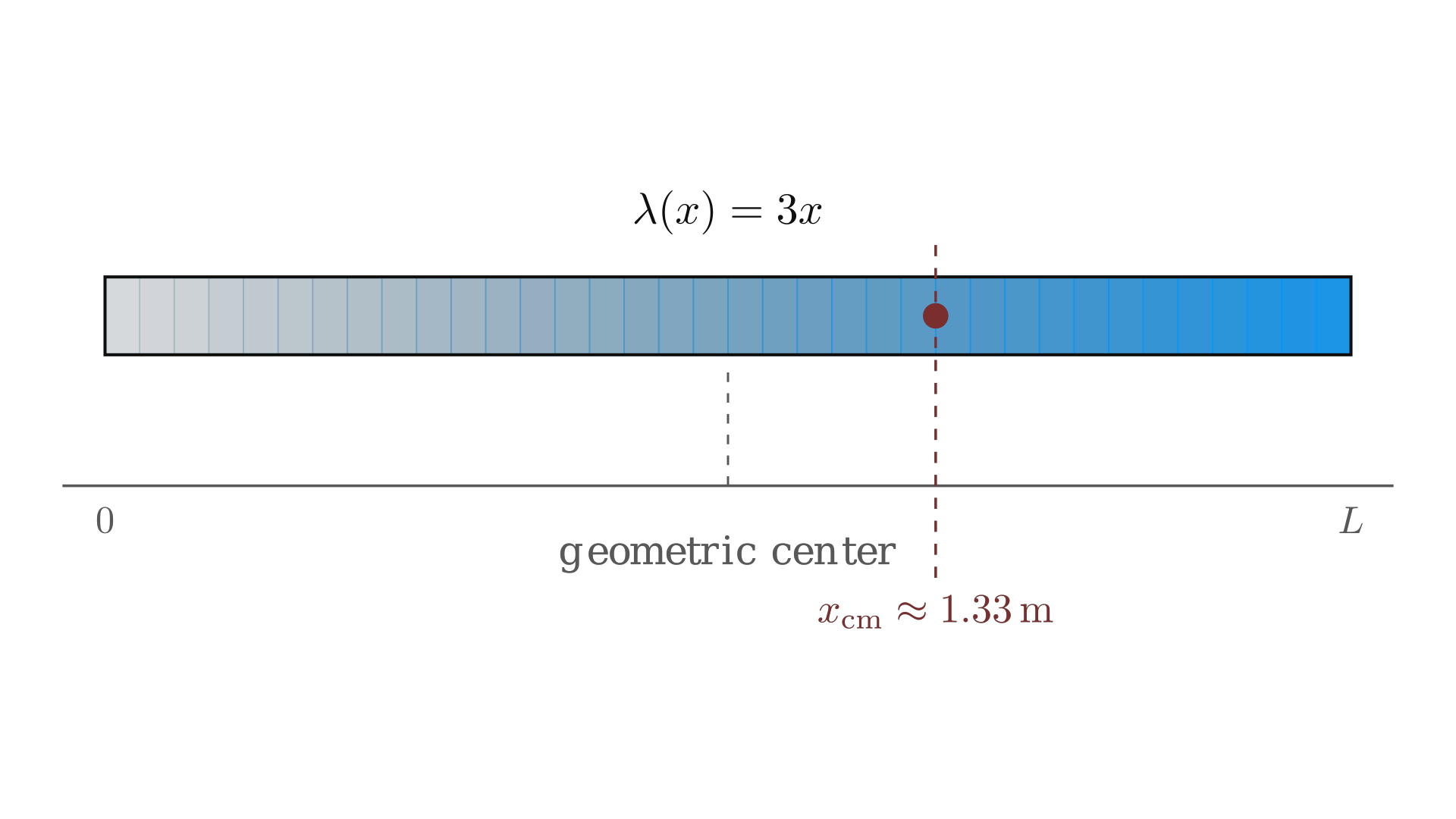
When you have a continuous mass distribution (like a rod with non-uniform density), you replace the sum with an integral. Split the object into infinitesimal mass elements \(dm\), each at position \(\vec{r}\):
对连续质量分布(例如非均匀密度的杆),把求和替换为积分(integral):将物体切分为位置为 \(\vec{r}\) 的无穷小质量元 \(dm\):
The trick is expressing \(dm\) in terms of the position variable. For a one-dimensional rod with linear mass density \(\lambda(x)\), we have \(dm = \lambda(x)\,dx\). The linear mass density is defined as:
关键技巧是把 \(dm\) 用位置变量表示。对于线密度(linear mass density)为 \(\lambda(x)\) 的一维杆,有 \(dm = \lambda(x)\,dx\)。线密度的定义为:
For two-dimensional or three-dimensional objects, you use surface mass density \(\sigma\) or volume mass density \(\rho\), respectively, and integrate over the appropriate domain. The total mass is always obtained by integrating the density:
对二维或三维物体,分别用面密度(surface mass density)\(\sigma\) 或体密度(volume mass density)\(\rho\),在相应的区域上积分。总质量始终由密度积分得到:
line of symmetry)上。均匀球的质心就是几何中心。均匀直角三角形的质心位于离直角顶点 \((\bar{x}, \bar{y}) = (b/3, h/3)\) 处。先利用对称性:它往往在动笔计算之前就确定了质心的一两个坐标。
Worked Example: Center of Mass of Three Particles例题:三个质点的质心
Three small masses lie in the $xy$-plane: $m_1 = 2.0$ kg at $(0, 0)$, $m_2 = 3.0$ kg at $(4.0, 0)$ m and $m_3 = 5.0$ kg at $(0, 2.0)$ m. Find the center of mass.
三个小质量块位于 $xy$ 平面内:$m_1 = 2.0$ kg 在 $(0, 0)$,$m_2 = 3.0$ kg 在 $(4.0, 0)$ m,$m_3 = 5.0$ kg 在 $(0, 2.0)$ m。求质心。
Worked Example: Non-Uniform Rod例题:非均匀杆 Physics C
A rod of length $L = 2$ m has linear mass density $\lambda(x) = 3x$ kg/m, where $x$ is measured from the left end. Find the center of mass.
长 $L = 2$ m 的杆,线密度 $\lambda(x) = 3x$ kg/m($x$ 从左端量起)。求质心。
Worked Example: Exploding Firework: CoM Trajectory (FRQ-style)例题:烟花爆炸:质心轨迹(FRQ 风格)
A 3.0 kg firework is launched at 40 m/s at $60°$ above horizontal. At the peak of its trajectory it explodes into two fragments: a 1.0 kg piece and a 2.0 kg piece. Immediately after the explosion, the 1.0 kg fragment is momentarily at rest.
一只 3.0 kg 的烟花以 40 m/s、与水平方向成 $60°$ 角发射。轨迹最高点处爆炸为 1.0 kg 与 2.0 kg 两块碎片。爆炸瞬间,1.0 kg 碎片瞬时静止。
(a) Find the velocity of the 2.0 kg fragment just after the explosion. (b) Where does the center of mass land, measured horizontally from the launch point? (Take $g = 10\;\text{m/s}^2$; ignore air resistance.)
(a) 求 2.0 kg 碎片爆炸后的速度;(b) 质心在水平方向距发射点多远落地?(取 $g = 10\;\text{m/s}^2$,忽略空气阻力。)
momentum)守恒:parabola)运动,仿佛没有发生爆炸:Checking Your Center-of-Mass Skills检验质心技能
State your system before you write any equation ("system: both blocks" or "system: the firework"), then list only the external forces on it. When a question asks whether an explosion, collision or push between parts changes the center-of-mass path, answer with the reason: the forces are internal, so $\vec{F}_\text{net,ext}$ and therefore $\vec{a}_\text{cm}$ are unchanged.
写任何方程之前先说明你选的系统(例如"系统:两个木块"或"系统:烟花"),然后只列出作用在系统上的外力。题目问爆炸、碰撞或部件之间的推力是否改变质心路径时,要连同理由作答:这些力是内力,所以 $\vec{F}_\text{net,ext}$ 不变,从而 $\vec{a}_\text{cm}$ 不变。
Give each center-of-mass coordinate with its unit and say which point you measured from.
给出质心的每个坐标时带上单位,并说明从哪一点量起。
A person stands on a skateboard and throws a ball forward. For the system "person + skateboard + ball", is the throwing force internal or external?一个人站在滑板上向前扔球。对于"人 + 滑板 + 球"这一系统,扔球的力是内力还是外力?
Internal. Both the agent (the person) and the target (the ball) are inside the system, and the reaction force of the ball on the person is also inside it, so the pair cancels in $\vec{F}_\text{net,ext}$. With friction and air resistance ignored, the system's center of mass does not accelerate horizontally.
内力。施力者(人)和受力者(球)都在系统内部,球对人的反作用力也在系统内部,所以这一对力在 $\vec{F}_\text{net,ext}$ 中相互抵消。忽略摩擦与空气阻力时,系统质心在水平方向上没有加速度。
A 4.0 kg mass sits at $x = 0$ and a 1.0 kg mass at $x = 5.0$ m. Where is the center of mass?4.0 kg 的质量位于 $x = 0$,1.0 kg 的质量位于 $x = 5.0$ m。质心在哪里?
$x_\text{cm} = \dfrac{(4.0)(0) + (1.0)(5.0)}{4.0 + 1.0} = \dfrac{5.0}{5.0} = 1.0$ m from the 4.0 kg mass, on the side of the lighter mass. It sits four times closer to the 4.0 kg mass than to the 1.0 kg mass (1.0 m against 4.0 m).
$x_\text{cm} = \dfrac{(4.0)(0) + (1.0)(5.0)}{4.0 + 1.0} = \dfrac{5.0}{5.0} = 1.0$ m,即从 4.0 kg 质量处向轻质量一侧 1.0 m。它到 4.0 kg 质量的距离只有到 1.0 kg 质量距离的四分之一(1.0 m 对 4.0 m)。
A uniform 2.0 m plank of mass 6.0 kg has a 3.0 kg box on its right end. How far from the left end is the center of mass of plank + box?一块长 2.0 m、质量 6.0 kg 的均匀木板,右端放着一个 3.0 kg 的箱子。"木板 + 箱子"的质心离左端多远?
By symmetry the plank acts as 6.0 kg at its midpoint, $x = 1.0$ m. The box is at $x = 2.0$ m. $x_\text{cm} = \dfrac{(6.0)(1.0) + (3.0)(2.0)}{6.0 + 3.0} = \dfrac{12}{9.0} \approx 1.33$ m from the left end. Treating the uniform plank as a point mass at its center is the symmetry shortcut in action.
由对称性,木板相当于位于其中点 $x = 1.0$ m 处的 6.0 kg 质点;箱子位于 $x = 2.0$ m。$x_\text{cm} = \dfrac{(6.0)(1.0) + (3.0)(2.0)}{6.0 + 3.0} = \dfrac{12}{9.0} \approx 1.33$ m(从左端量起)。把均匀木板看作位于中心的质点,正是对称性捷径的应用。
Forces & Free-Body Diagrams力与受力分析图
- Identify the agent and the target of every force acting on an object.
- Distinguish contact forces from forces that act at a distance through a field.
- Draw a free-body diagram with each force as an arrow from a dot that represents the object.
- Choose axes along and perpendicular to the acceleration, and resolve forces into components there.
- Write $\sum F_x = ma_x$ and $\sum F_y = ma_y$ from a free-body diagram and solve them.
- 指认(
identify)作用在物体上的每个力的施力者与受力者。 - 区分(
distinguish)接触力与通过场远距离作用的力。 - 画出(
draw)受力分析图:物体用一个点表示,每个力画成从该点出发的箭头。 - 沿加速度方向及其垂直方向选取坐标轴,并在这两个方向上分解力。
- 由受力分析图写出 $\sum F_x = ma_x$ 与 $\sum F_y = ma_y$ 并求解。
A force is a vector quantity describing an interaction between two objects. Every force has an agent (the object exerting the force) and a target (the object experiencing the force). This two-object requirement is absolute: if you cannot name both the agent and the target, you don't have a real force.
力(force)是描述两个物体相互作用的矢量。每个力都有一个"施力者(agent)"和一个"受力者(target)"。这"两物体"的要求是绝对的:如果叫不出施力者和受力者,那就不是真正的力。
Contact forces (normal, friction, tension, applied push) arise from interatomic electric interactions when surfaces touch. Non-contact forces (gravity, electromagnetic) act at a distance through fields.
接触力(法向力 normal force、摩擦力 friction、张力 tension、外加推力)来自表面接触时的原子级电相互作用;非接触力(引力、电磁力)通过场在远距离作用。
An object or system cannot exert a net force on itself. This is a subtle but crucial point: when you see a car "accelerating itself," the car's engine pushes the tires backward against the road, and the road pushes the tires forward via friction. The external force that actually accelerates the car comes from the ground.
一个物体或系统无法对自己施加净力。这一点微妙但极其关键:汽车看似"自己加速",其实是发动机驱动轮胎向后蹬地,地面通过摩擦把轮胎向前推,真正让汽车加速的外力来自地面。
Drawing Free-Body Diagrams绘制受力分析图
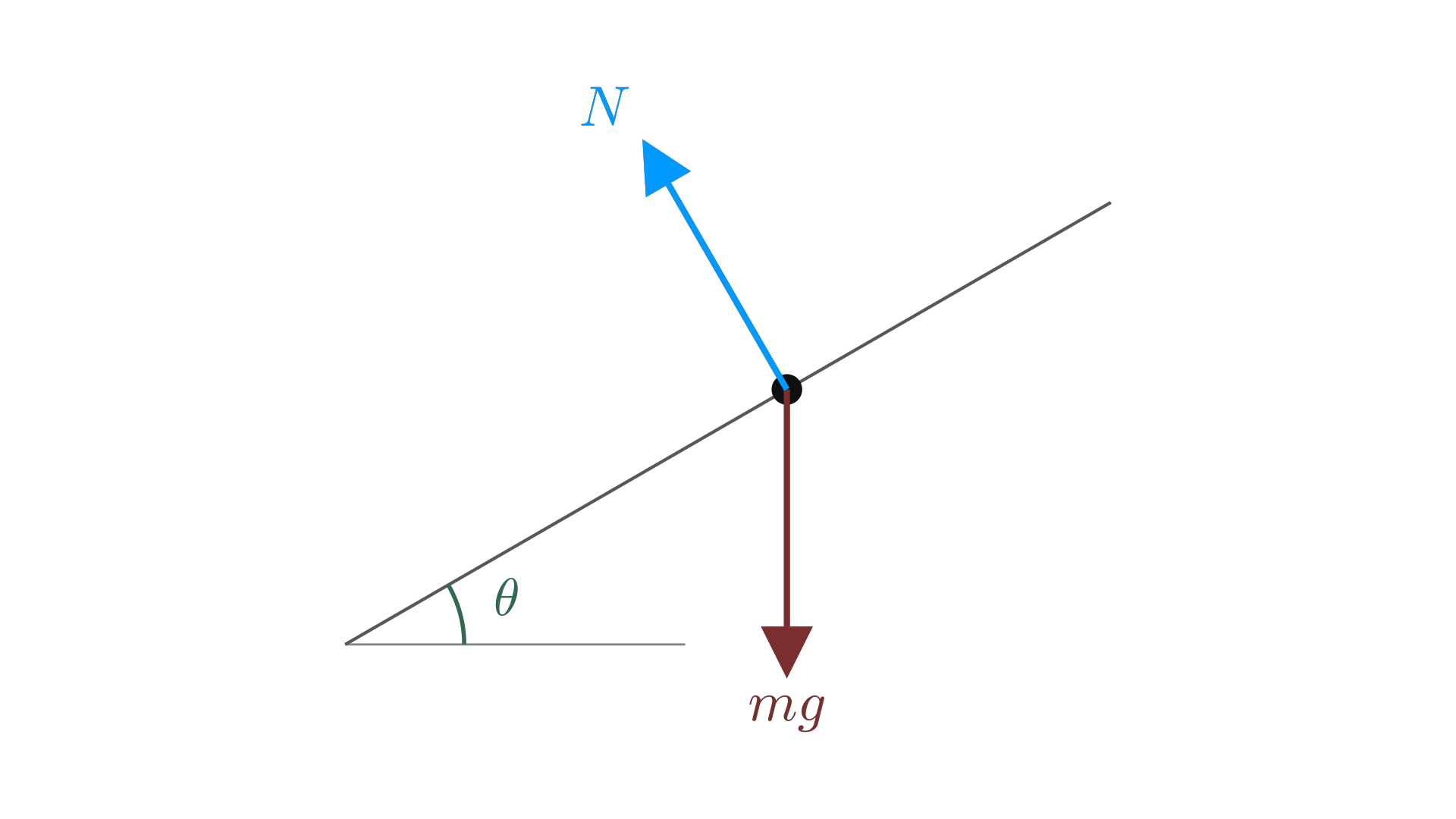
A free-body diagram (FBD) is your most important problem-solving tool. It isolates a single object, represents it as a dot (its center of mass), and shows every external force acting on it as an arrow originating from that dot. The arrow's direction shows the force direction and relative length indicates relative magnitude.
受力分析图(free-body diagram / FBD)是你最重要的解题工具。它把单个物体单独取出,用一个点表示(即其质心),然后把作用其上的每一个外力画成从该点出发的箭头。箭头方向表示力的方向,相对长度表示相对大小。
components),只画真实的力。先画完 FBD 再建立坐标系,并尽量让一条坐标轴沿加速度方向(例如斜面问题中沿斜面方向)。
centripetal force)"作为单独的力画上去,它是径向净力,不是新增的一个力;(4) 重力(gravity)总是指向正下方;(5) 法向力(normal force)垂直于接触面,并不一定指向正上方。
Worked Example: Block on an Inclined Plane例题:斜面上的木块
A block of mass \(m\) is released from rest on a frictionless incline of angle \(\theta\). Find the normal force and the block's acceleration.
质量为 \(m\) 的木块在角度为 \(\theta\) 的无摩擦斜面(inclined plane)上由静止释放。求法向力和木块的加速度。
FBD forces on the block:
• Weight mg straight down (agent: Earth)
• Normal force N perpendicular to surface (agent: incline)
木块的 FBD 中有两个力:
• 重力 mg 竖直向下(施力者:地球)
• 法向力 N 垂直于斜面(施力者:斜面)
free fall) ✓。Worked Example: Box Pulled by an Angled Rope例题:被斜拉绳拉动的箱子
A 10.0 kg box sits on a frictionless floor. A rope pulls on it with a tension of 40.0 N at $30.0°$ above the horizontal. Find the normal force and the acceleration. Use $g = 9.8\;\text{m/s}^2$.
一个 10.0 kg 的箱子放在无摩擦地面上,一根绳以 40.0 N 的张力、与水平方向成 $30.0°$ 向上拉它。求法向力与加速度。取 $g = 9.8\;\text{m/s}^2$。
When a question asks for a free-body diagram, draw only the real forces as arrows starting on the dot, label each one with a symbol you define ($F_g$ or $mg$, $F_N$, $T$, $f_k$), and keep arrows in the same direction side by side so both are visible. Leave out components and the "net force".
题目要求画受力分析图时,只把真实的力画成从点出发的箭头,每个箭头用你定义的符号标注($F_g$ 或 $mg$、$F_N$、$T$、$f_k$),同方向的箭头并排画,使两者都能看见。不要画分量,也不要画"净力"。
After the diagram, state your axes in words ("$+x$ down the slope") before writing $\sum F = ma$ along each axis.
画完图后先用文字说明坐标轴(例如"$+x$ 沿斜面向下"),再沿每个轴写 $\sum F = ma$。
A ball is in flight after leaving a bat (ignore air resistance). Which forces belong on its free-body diagram?球被球棒击出后在空中飞行(忽略空气阻力)。它的受力分析图上应画哪些力?
Only the gravitational force of Earth on the ball, pointing straight down. The bat is no longer touching the ball, so there is no "force of the hit"; the ball keeps moving because of its velocity, not because a force pushes it forward.
只有地球对球的引力,竖直向下。球棒已不再接触球,所以不存在"击打力";球继续运动是因为它有速度,而不是有力在向前推它。
On an incline of angle $\theta$, which direction does the normal force point, and why is it not simply "up"?在倾角为 $\theta$ 的斜面上,法向力指向哪里?为什么它不是简单的"向上"?
Perpendicular to the incline surface, away from it. The normal force is the perpendicular part of the contact force, so it follows the surface, not the vertical. Its magnitude is $mg\cos\theta$ only when no other force has a component perpendicular to the surface.
垂直于斜面、背离斜面。法向力是接触力中垂直于接触面的部分,所以它跟随接触面的方向,而不是竖直方向。只有在没有其他力具有垂直于斜面的分量时,它的大小才等于 $mg\cos\theta$。
A 5.0 kg block on a frictionless floor is pushed by a 30 N force directed $20°$ below the horizontal. Find the normal force and the acceleration ($g = 9.8\;\text{m/s}^2$).无摩擦地面上 5.0 kg 的木块受到一个与水平方向成 $20°$ 斜向下的 30 N 推力。求法向力与加速度($g = 9.8\;\text{m/s}^2$)。
Vertical: $N - mg - F\sin 20° = 0$, so $N = 49 + 30(0.342) = 49 + 10.3 = 59.3$ N. Horizontal: $a = \dfrac{F\cos 20°}{m} = \dfrac{30(0.940)}{5.0} = 5.6\;\text{m/s}^2$. Pushing downward at an angle increases the normal force above $mg$.
竖直方向:$N - mg - F\sin 20° = 0$,所以 $N = 49 + 30(0.342) = 49 + 10.3 = 59.3$ N。水平方向:$a = \dfrac{F\cos 20°}{m} = \dfrac{30(0.940)}{5.0} = 5.6\;\text{m/s}^2$。斜向下推会使法向力大于 $mg$。
Newton's Third Law牛顿第三定律
- State Newton's third law and identify third-law force pairs.
- Explain why a third-law pair never cancels on a single free-body diagram.
- Explain why internal forces cancel when a whole system is analyzed.
- Calculate tension in an ideal string, including over an ideal pulley.
- Calculate the acceleration and tension of an Atwood machine.
- Explain how the tension varies along a rope, cable or chain whose mass is not negligible.
- Calculate the tension at a point of a hanging rope of uniform linear density from the weight of rope below it, $T(y) = \lambda g y$.
- 陈述(
state)牛顿第三定律,并指认第三定律对偶力。 - 解释(
explain)为什么一对第三定律对偶力绝不会在同一张受力分析图上相互抵消。 - 解释为什么分析整个系统时内力相互抵消。
- 计算(
calculate)理想绳中的张力,包括绕过理想滑轮的情形。 - 计算阿特伍德机(
Atwood machine)的加速度与张力。 - 解释(
explain)质量不可忽略的绳、缆或链上张力如何沿长度变化。 - 由悬挂的均匀线密度绳下方部分的重力,计算绳上某点的张力 $T(y) = \lambda g y$。
Newton's third law states that when object A exerts a force on object B, then B simultaneously exerts a force on A that is equal in magnitude and opposite in direction:
牛顿第三定律(Newton's third law)指出:当物体 A 对物体 B 施加一个力时,B 同时对 A 施加一个大小相等、方向相反的力:
A critical consequence: internal forces within a system always cancel pairwise. Only external forces can change the momentum (or accelerate the center of mass) of a system. This is why choosing your system boundary wisely is so powerful.
一个关键推论:系统内部的内力总是成对相互抵消。只有外力能改变系统的动量(或者说让系统质心加速)。这正是聪明地选取系统边界为何如此强大的原因。
Third-Law Pairs versus Balanced Forces第三定律对偶力与平衡力的区别
Two equal and opposite forces are not automatically a third-law pair. The test is which objects they act on.
两个大小相等、方向相反的力不一定是第三定律对偶力。判断标准是它们作用在哪些物体上。
| Feature特征 | Third-law pair第三定律对偶力 | Balanced forces on one object同一物体上的平衡力 |
|---|---|---|
| Acts on作用对象 | two different objects两个不同的物体 | the same object同一个物体 |
| Type of force力的种类 | always the same type (both gravitational, both normal)总是同一种力(都是引力,或都是法向力) | may be different types (normal force and weight)可以是不同种类(法向力与重力) |
| Equal magnitudes?大小相等吗? | always, even while the objects accelerate总是相等,即使物体在加速 | only when the object does not accelerate along that line仅当物体沿该方向不加速时 |
| Cancel on one free-body diagram?在一张受力分析图上抵消吗? | never: each diagram shows only one of the two绝不:每张图上只出现其中一个 | yes: they sum to zero是:二者之和为零 |
| Book resting on a table静置在桌上的书 | Earth pulls the book down; the book pulls Earth up地球把书向下拉;书把地球向上拉 | table pushes the book up; Earth pulls the book down桌子把书向上推;地球把书向下拉 |
Tension in Strings绳中的张力
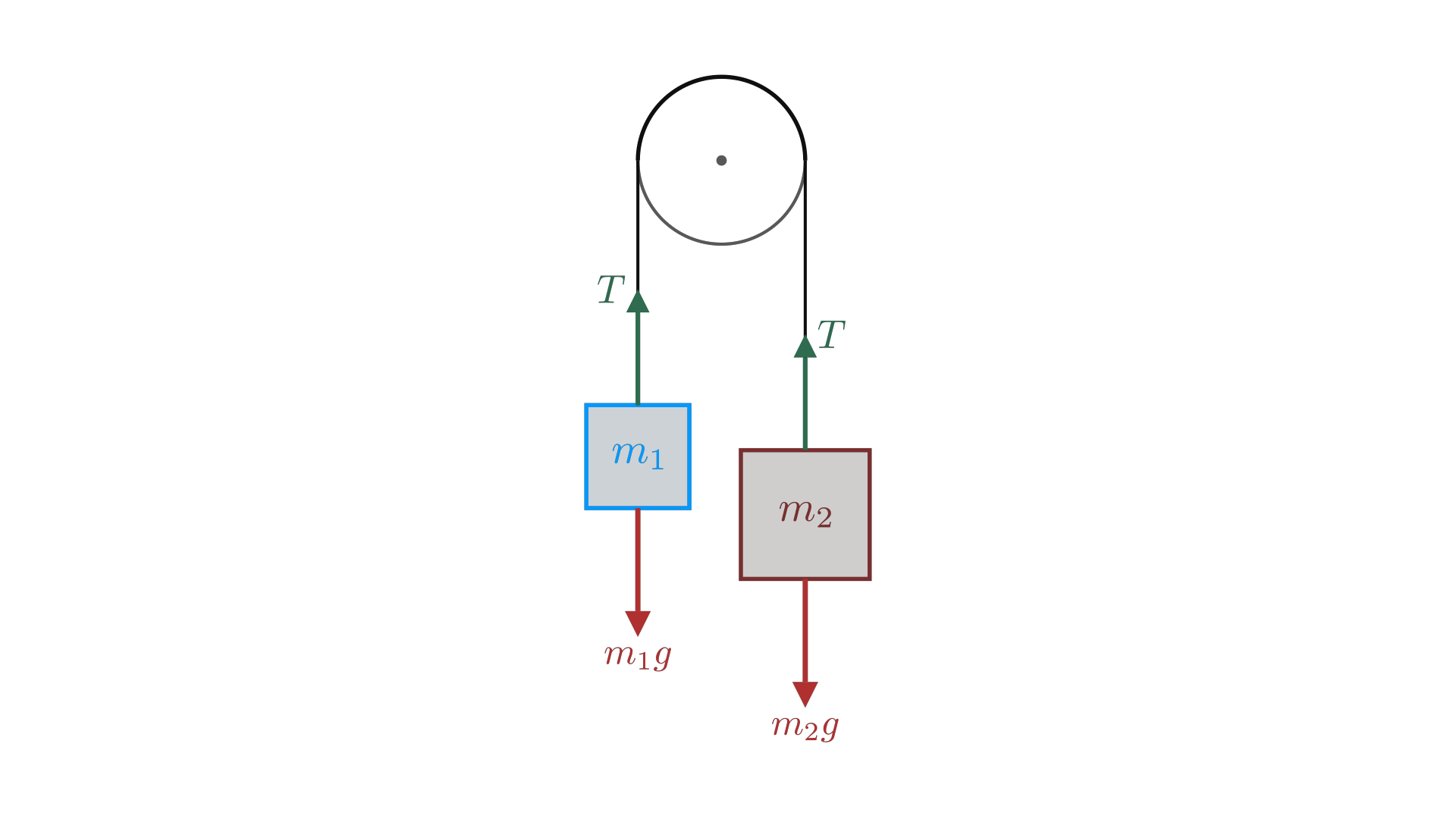
Tension is the macroscopic result of countless interatomic forces along a string, rope, or cable. For an ideal string (massless and inextensible), the tension is the same at every point. When the string has mass, however, different segments may experience different tensions, a key distinction in more advanced problems.
张力(tension)是绳、索内部无数个原子间作用力的宏观体现。对于理想绳(ideal string,无质量且不可伸长),整根绳上每一点的张力都相同。当绳本身有质量时,不同位置的张力可以不同,这在更高阶题目中是关键的区分。
An ideal pulley has negligible mass and frictionless axle. It simply redirects the tension without changing its magnitude. A non-ideal (massive) pulley will be revisited in Unit 5 with rotational dynamics.
理想滑轮(ideal pulley)的质量可忽略、轴上无摩擦,只改变张力方向、不改变其大小。有质量的非理想滑轮要等到第 5 单元的转动动力学才会再次出现。
First Principles: The Atwood Machine Acceleration第一性原理:阿特伍德机的加速度
Principle. Apply Newton's second law to each hanging mass ($m_2 > m_1$). An ideal string and pulley give both masses the same tension $T$ and the same size of acceleration $a$.
原理。对每个悬挂物体($m_2 > m_1$)应用牛顿第二定律。理想绳与理想滑轮使两物体受相同的张力 $T$,加速度大小 $a$ 也相同。
- Heavier mass, positive downward: $m_2g-T=m_2a$.
- Lighter mass, positive upward: $T-m_1g=m_1a$.
- Add the two equations. $T$ is internal to the two-mass system and cancels: $(m_2-m_1)g=(m_1+m_2)a$, so $a=\dfrac{(m_2-m_1)g}{m_1+m_2}$.
- Substitute back: $T=m_1(g+a)=\dfrac{2m_1m_2g}{m_1+m_2}$.
- 较重物体,取向下为正:$m_2g-T=m_2a$。
- 较轻物体,取向上为正:$T-m_1g=m_1a$。
- 两式相加。$T$ 是两物体系统的内力,相互抵消:$(m_2-m_1)g=(m_1+m_2)a$,所以 $a=\dfrac{(m_2-m_1)g}{m_1+m_2}$。
- 回代:$T=m_1(g+a)=\dfrac{2m_1m_2g}{m_1+m_2}$。
Limiting-case check. Equal masses give $a=0$ and $T=mg$. As $m_1\to0$, $a\to g$ and $T\to0$: $m_2$ falls freely. Units: $\mathrm{kg\cdot(m/s^2)/kg}=\mathrm{m/s^2}$.
极限检验。两质量相等时 $a=0$,$T=mg$。当 $m_1\to0$ 时,$a\to g$,$T\to0$:$m_2$ 自由下落。单位:$\mathrm{kg\cdot(m/s^2)/kg}=\mathrm{m/s^2}$。
Tension in a Rope with Mass有质量的绳中的张力
The ideal-string rule (the same tension everywhere) fails when a rope, cable or chain has non-negligible mass. Take a chain hanging at rest from a ceiling.
当绳、缆或链的质量不可忽略时,理想绳"各处张力相同"的规则不再成立。设想一条静止悬挂在天花板上的链子。
Each link must support the weight of everything below it, so the tension is greatest at the top, where it equals the weight of the whole chain, and it decreases steadily to zero at the free bottom end.
每一环都必须支撑它下方所有部分的重力,所以顶端张力最大,等于整条链的重力,并向下逐渐减小,在自由的下端为零。
If the rope also accelerates, the tension difference between two points is the net force that the segment between them needs: with up positive, $T_\text{upper} - T_\text{lower} - m_\text{seg}\,g = m_\text{seg}\,a$.
若绳还在加速,则两点间的张力差就是这两点之间那一段所需的净力:取向上为正,$T_\text{upper} - T_\text{lower} - m_\text{seg}\,g = m_\text{seg}\,a$。
Physics C For a uniform rope of mass $M$ and length $L$ (linear density $\lambda = M/L$) hanging at rest, the part of the rope a distance $y$ above the free end weighs $\lambda g y$, so $T(y) = \int_0^y \lambda g\,dy' = \lambda g y = Mg\,\dfrac{y}{L}$. The tension grows linearly from $0$ at the free end to $Mg$ at the top.
Physics C 对质量 $M$、长度 $L$(线密度 $\lambda = M/L$)的均匀绳静止悬挂,自由端以上距离 $y$ 处的那一段绳重 $\lambda g y$,所以 $T(y) = \int_0^y \lambda g\,dy' = \lambda g y = Mg\,\dfrac{y}{L}$。张力从自由端的 $0$ 线性增大到顶端的 $Mg$。
Worked Example: Atwood Machine例题:阿特伍德机(Atwood machine)
Two masses \(m_1\) and \(m_2\) (\(m_2 > m_1\)) hang over an ideal (massless, frictionless) pulley. Find the acceleration and tension.
两个质量 \(m_1\) 与 \(m_2\)(\(m_2 > m_1\))挂在理想(无质量、无摩擦)滑轮两侧。求加速度与张力。
Treat the string as ideal: same tension T on both sides.
For m₁ (take up as positive):
把绳视为理想绳:两侧张力 T 相同。
对 m₁(取向上为正):
Worked Example: Atwood Machine with Numbers例题:代入数值的阿特伍德机
Masses $m_1 = 3.0$ kg and $m_2 = 5.0$ kg hang from an ideal string over an ideal pulley and are released from rest. Find the acceleration and the tension. Use $g = 9.8\;\text{m/s}^2$.
质量 $m_1 = 3.0$ kg 与 $m_2 = 5.0$ kg 用理想绳挂在理想滑轮两侧,由静止释放。求加速度与张力。取 $g = 9.8\;\text{m/s}^2$。
Worked Example: Two Skaters Push Apart例题:两名滑冰者互推
On frictionless ice, skater A (60 kg) pushes skater B (40 kg) with a force of 120 N. Find the force on A and the acceleration of each skater during the push.
在无摩擦冰面上,滑冰者 A(60 kg)以 120 N 的力推滑冰者 B(40 kg)。求推的过程中 A 所受的力以及两人各自的加速度。
When you name a third-law pair, write it in the form "force of A on B" and "force of B on A": same two objects, same type of force, opposite directions.
指出第三定律对偶力时,写成"A 对 B 的力"与"B 对 A 的力"的形式:同一对物体、同一类力、方向相反。
A question that compares the forces in a collision between a truck and a car is answered by the third law (equal magnitudes); a question that compares their accelerations needs the second law as well. For pulleys and strings, write one $\sum F = ma$ equation per object with its own sign convention, then add them.
比较卡车与小汽车相撞时的力,用第三定律回答(大小相等);比较它们的加速度,还需要第二定律。对滑轮与绳的问题,每个物体各写一个 $\sum F = ma$ 方程并各自约定正方向,然后把方程相加。
A truck collides head-on with a small car. Which experiences the larger force? The larger acceleration?卡车与小汽车迎面相撞。哪一个受到的力更大?哪一个的加速度更大?
The forces are equal in magnitude: they are a third-law pair (truck on car, car on truck). The car has the larger acceleration because $a = F/m$ and its mass is smaller.
两个力大小相等:它们是一对第三定律对偶力(卡车对汽车、汽车对卡车)。小汽车的加速度更大,因为 $a = F/m$,而它的质量更小。
"If the horse pulls the cart and the cart pulls back equally on the horse, the forces cancel and nothing can move." What is wrong with this argument?"马拉车,车以同样大的力拉马,两力抵消,所以什么都动不了。"这个论证错在哪里?
The two forces act on different objects, so they never appear on the same free-body diagram and cannot cancel. The cart accelerates if the horse's pull on it exceeds the friction on the cart; the horse accelerates if the ground's forward friction on its hooves exceeds the cart's backward pull on it.
这两个力作用在不同物体上,永远不会出现在同一张受力分析图上,因此不能抵消。只要马对车的拉力大于车受到的摩擦力,车就加速;只要地面对马蹄向前的摩擦力大于车对马向后的拉力,马就加速。
On a frictionless table, a 24 N force pulls a 2.0 kg block, which pulls a 4.0 kg block behind it by an ideal string. Find the acceleration and the string tension.在无摩擦桌面上,24 N 的力拉着一个 2.0 kg 的木块,它再通过理想绳拉着后面一个 4.0 kg 的木块。求加速度与绳中张力。
System: $a = \dfrac{24}{2.0 + 4.0} = 4.0\;\text{m/s}^2$. The string is the only horizontal force on the rear block: $T = (4.0)(4.0) = 16$ N. Check on the front block: $24 - 16 = 8.0\;\text{N} = (2.0)(4.0)$.
系统:$a = \dfrac{24}{2.0 + 4.0} = 4.0\;\text{m/s}^2$。绳的拉力是后面木块所受唯一的水平力:$T = (4.0)(4.0) = 16$ N。用前面木块检验:$24 - 16 = 8.0\;\text{N} = (2.0)(4.0)$。
A uniform chain of mass $4.0$ kg hangs at rest from a ceiling. Find the tension at the top, at the midpoint and at the free bottom end ($g = 10\;\text{m/s}^2$).质量 $4.0$ kg 的均匀链静止悬挂在天花板上。求顶端、中点和自由下端处的张力($g = 10\;\text{m/s}^2$)。
Top: the whole chain hangs from it, $T = Mg = (4.0)(10) = 40$ N. Midpoint: it supports the lower half, $2.0$ kg, so $T = (2.0)(10) = 20$ N. Bottom: nothing hangs below, so $T = 0$. The tension falls steadily from top to bottom, unlike an ideal string, where it would be the same everywhere.
顶端:整条链挂在这里,$T = Mg = (4.0)(10) = 40$ N。中点:它支撑下半部分 $2.0$ kg,所以 $T = (2.0)(10) = 20$ N。下端:下面没有悬挂物,所以 $T = 0$。张力从顶端到下端逐渐减小,不像理想绳那样各处相同。
Physics C The same result follows from $T(y) = \lambda g y$ with $\lambda = 4.0/L$: at $y = L/2$, $T = (4.0/L)(10)(L/2) = 20$ N.
Physics C 由 $T(y) = \lambda g y$($\lambda = 4.0/L$)得到同样的结果:在 $y = L/2$ 处,$T = (4.0/L)(10)(L/2) = 20$ N。
A uniform chain hangs at rest from a ceiling. Rank the tension at the top, at the midpoint and at the free bottom end, and explain your ranking.一条均匀的链静止悬挂在天花板上。比较顶端、中点和自由下端处的张力大小,并解释你的排序。
Top > midpoint > bottom. Each point must support the weight of the chain below it: the top supports the whole chain, the midpoint supports only the lower half, and the free bottom end supports nothing below it. The tension therefore decreases steadily from top to bottom, unlike an ideal string, where it would be the same everywhere.
顶端 > 中点 > 下端。每一处都必须支撑它下方那部分链的重力:顶端支撑整条链,中点只支撑下半部分,自由下端下面没有任何东西。因此张力从顶端到下端逐渐减小,不像理想绳那样各处相同。
Newton's First Law牛顿第一定律
- State Newton's first law and describe what an inertial reference frame is.
- Explain why equilibrium means constant velocity, not necessarily rest.
- Apply $\sum F_x = 0$ and $\sum F_y = 0$ separately to an object in translational equilibrium.
- Calculate unknown tensions or friction forces for an object at rest or moving at constant velocity.
- Deduce from a motion description whether the net force on an object is zero.
- 陈述(
state)牛顿第一定律,并描述什么是惯性参考系。 - 解释(
explain)为什么平衡意味着速度恒定,而不一定是静止。 - 对处于平动平衡的物体分别应用 $\sum F_x = 0$ 与 $\sum F_y = 0$。
- 计算(
calculate)静止或匀速运动物体所受的未知张力或摩擦力。 - 根据运动描述推断(
deduce)物体所受净力是否为零。
Newton's first law states: if the net force exerted on a system is zero, the velocity of that system remains constant. An object at rest stays at rest; an object in motion continues in a straight line at constant speed.
牛顿第一定律(Newton's first law):如果系统所受净力为零,则其速度保持不变。静止物体保持静止,运动物体则沿直线匀速继续。
This is not just a special case of the second law; it also defines what an inertial reference frame is: one in which Newton's first law holds true. Earth's surface is approximately inertial for most problems; a spinning merry-go-round is not.
它不仅是第二定律的特例,同时也定义了惯性参考系(inertial reference frame):在其中牛顿第一定律成立。地球表面对大多数题目而言可近似为惯性参考系;旋转的旋转木马则不是。
In 1687 Isaac Newton published the Philosophiæ Naturalis Principia Mathematica, in Latin. After a set of definitions, it states his three Laws of Motion; Law I is the first law above.
1687 年,牛顿用拉丁文出版了《自然哲学的数学原理》(Principia)。书中在一组定义之后给出了三条运动定律;定律一就是上面的第一定律。
Book III applies the same laws to the sky. Its "Moon test" weakens Earth's gravity by $60^2$ at the Moon's distance (about 60 Earth radii), giving about $2.7\times10^{-3}\;\mathrm{m/s^2}$, the Moon's observed centripetal acceleration.
第三卷把同样的定律用于天体。其中的"月球检验"(Moon test)把地球引力在月球距离(约 60 个地球半径)处减弱为 $1/60^2$,得到约 $2.7\times10^{-3}\;\mathrm{m/s^2}$,正是观测到的月球向心加速度。
Wikipedia: Principia (contents of the three books and the laws of motion)维基百科:《原理》(三卷内容与运动定律)
translational equilibrium)Forces may be balanced in one direction but unbalanced in another. A ball rolling along a horizontal surface (no friction, no air resistance) has balanced vertical forces (\(N = mg\)) but if there's a crosswind, there's an unbalanced horizontal force causing the ball to accelerate sideways. Always analyze each dimension independently.
力在某一方向上平衡,并不意味着另一方向也平衡。无摩擦、无空气阻力地面上滚动的球,竖直方向力平衡(\(N = mg\));若有侧风,水平方向就有不平衡的力,使球沿侧向加速。务必对每一坐标方向单独分析。
equilibrium)意味着净力为零,从而速度恒定,但不一定为零。以终极速度(terminal velocity)下落的跳伞员处于平衡。无摩擦冰面上匀速滑行的冰球也处于平衡。不要把"不加速"等同于"不动"。
Worked Example: Traffic Light Hung from Two Cables例题:两根缆绳悬挂的交通灯
A 200 N traffic light hangs at rest from two identical cables, each making $30°$ below the horizontal on either side. Find the tension in each cable.
一盏重 200 N 的交通灯由两根相同的缆绳悬挂而静止,两根缆绳在两侧各与水平方向成 $30°$ 向下倾斜。求每根缆绳的张力。
Worked Example: Crate Dragged at Constant Velocity例题:匀速拖动的木箱
A 30 kg crate is pulled across a level floor at constant velocity by a horizontal force of 120 N. Find the friction force and the coefficient of kinetic friction. Use $g = 9.8\;\text{m/s}^2$.
一个 30 kg 的木箱在水平地面上被 120 N 的水平拉力匀速拉动。求摩擦力与动摩擦系数。取 $g = 9.8\;\text{m/s}^2$。
Watch for the words "at rest", "constant velocity", "constant speed in a straight line" and "terminal velocity": each one tells you $\sum \vec{F} = \vec{0}$. Write the two balance equations separately ($\sum F_x = 0$, $\sum F_y = 0$) before you substitute numbers.
留意"静止""匀速""沿直线以恒定速率""终极速度"这些字眼:它们都意味着 $\sum \vec{F} = \vec{0}$。代入数值之前,先分别写出两个平衡方程($\sum F_x = 0$、$\sum F_y = 0$)。
A justification such as "the tension equals the weight because the velocity is constant, so the acceleration and the net force are zero" names the law and the reason; "because it is moving up" is not a reason.
像"张力等于重力,因为速度恒定,所以加速度和净力都为零"这样的论证同时说出了定律和理由;"因为它在向上运动"不是理由。
A ball thrown straight up is momentarily at rest at the top of its path. Is it in equilibrium there?竖直上抛的球在最高点瞬时静止。它在那里处于平衡吗?
No. Its velocity is zero for an instant, but the net force is still its weight $mg$ downward, so its acceleration is $g$ downward and its velocity changes immediately. Equilibrium requires zero net force, not zero velocity.
不是。它的速度只在一瞬间为零,但净力仍是向下的重力 $mg$,所以加速度为向下的 $g$,速度立刻发生变化。平衡要求净力为零,而不是速度为零。
A car drives along a straight highway at a steady 25 m/s. What is the net force on it, and which forces balance?一辆汽车在笔直的公路上以 25 m/s 匀速行驶。它所受净力是多少?哪些力相互平衡?
Zero, because the velocity is constant. Vertically, the normal forces balance the weight; horizontally, the forward friction of the road on the drive wheels balances air resistance and rolling resistance.
零,因为速度恒定。竖直方向,法向力与重力平衡;水平方向,路面对驱动轮向前的摩擦力与空气阻力和滚动阻力平衡。
A 5.0 kg picture hangs at rest from two wires: wire 1 is horizontal and wire 2 makes $60°$ above the horizontal. Find both tensions ($g = 9.8\;\text{m/s}^2$).一幅 5.0 kg 的画由两根细线悬挂而静止:线 1 水平,线 2 与水平方向成 $60°$ 向上。求两根线的张力($g = 9.8\;\text{m/s}^2$)。
Vertical: $T_2\sin 60° = mg = 49$ N, so $T_2 = 49/0.866 \approx 56.6$ N. Horizontal: $T_1 = T_2\cos 60° = 56.6(0.500) \approx 28.3$ N. Only wire 2 has a vertical component, so it alone supports the weight.
竖直方向:$T_2\sin 60° = mg = 49$ N,所以 $T_2 = 49/0.866 \approx 56.6$ N。水平方向:$T_1 = T_2\cos 60° = 56.6(0.500) \approx 28.3$ N。只有线 2 有竖直分量,所以重量完全由它承担。
Newton's Second Law牛顿第二定律
- State Newton's second law in the form $\vec{a} = \vec{F}_\text{net}/m$ and explain the direction of $\vec{a}$.
- Apply the second law to a whole system and to each object in it, and explain when each choice is useful.
- Calculate an internal force (contact force or tension) after finding the system acceleration.
- Combine a constant net force with the kinematic equations to find velocity and displacement.
- Calculate $v(t)$ and $x(t)$ for a force given as a function of time by integrating $a = F(t)/m$.
- Calculate speed as a function of position for a force $F(x)$ using $a = v\,dv/dx$.
- 以 $\vec{a} = \vec{F}_\text{net}/m$ 的形式陈述(
state)牛顿第二定律,并说明 $\vec{a}$ 的方向。 - 对整个系统以及系统中的每个物体应用第二定律,并解释(
explain)各自适用的场合。 - 先求系统加速度,再计算(
calculate)内力(接触力或张力)。 - 把恒定净力与运动学方程结合,求速度与位移。
- 对随时间变化的力,通过对 $a = F(t)/m$ 积分计算 $v(t)$ 与 $x(t)$。
- 对随位置变化的力 $F(x)$,利用 $a = v\,dv/dx$ 计算速率随位置的变化。
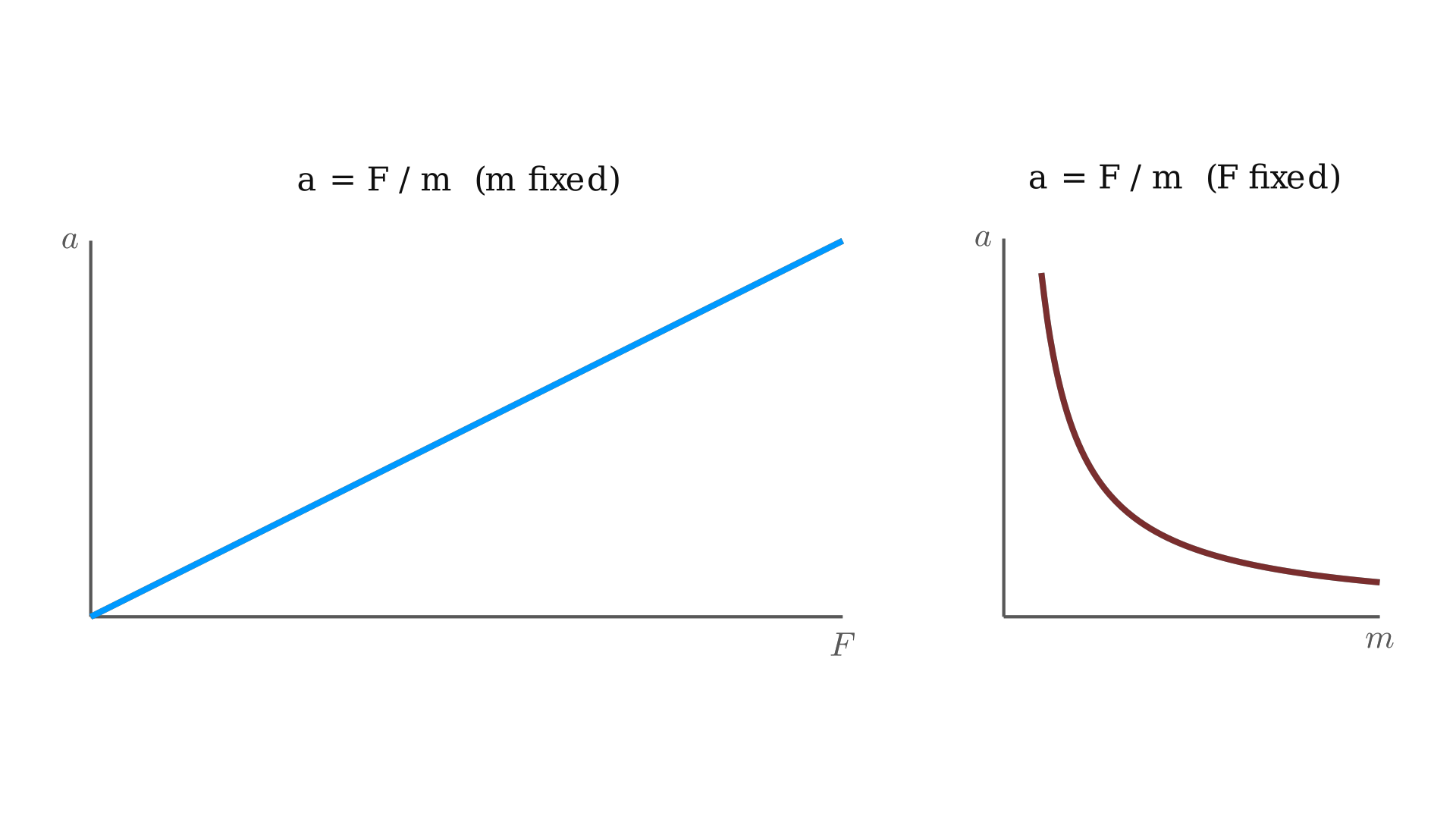
Newton's second law is the backbone of classical mechanics. It states that the acceleration of a system's center of mass is proportional to the net external force and inversely proportional to the total mass:
牛顿第二定律(Newton's second law)是经典力学的脊梁:系统质心的加速度与净外力(net external force)成正比、与总质量(mass)成反比:
The problem-solving strategy for any dynamics problem is: (1) identify the system, (2) draw a free-body diagram, (3) choose a coordinate system, (4) write \(\sum F_x = ma_x\) and \(\sum F_y = ma_y\), (5) solve the resulting system of equations.
所有动力学题目都可用同一套流程:(1) 选定系统;(2) 画 FBD;(3) 建立坐标系;(4) 写出 \(\sum F_x = ma_x\) 与 \(\sum F_y = ma_y\);(5) 求解联立方程组。
The calculus connection is that force and acceleration are related to velocity and position through derivatives: \(a = dv/dt = d^2x/dt^2\), so Newton's second law becomes a differential equation when forces depend on velocity or position.
微积分上的关键关联:力与加速度通过导数(derivative)与速度、位置相联:\(a = dv/dt = d^2x/dt^2\)。当力依赖于速度或位置时,牛顿第二定律就变成微分方程。
The problem-solving strategy for any dynamics problem is: (1) identify the system, (2) draw a free-body diagram, (3) choose a coordinate system, (4) write $\sum F_x = ma_x$ and $\sum F_y = ma_y$, (5) solve the resulting system of equations.
所有动力学题目都可用同一套流程:(1) 选定系统;(2) 画 FBD;(3) 建立坐标系;(4) 写出 $\sum F_x = ma_x$ 与 $\sum F_y = ma_y$;(5) 求解联立方程组。
The acceleration you find is the link to motion: when the net force is constant, the acceleration is constant, so the kinematic equations from Unit 1 give velocity and position; when the force changes in steps, treat each interval separately.
求出的加速度把力与运动联系起来:净力恒定时加速度恒定,用第 1 单元的运动学方程即可求速度与位置;力分段变化时,对每一段分别处理。
Choosing the System选择研究对象
Worked Example: Two Blocks on a Surface例题:平面上的两个木块
An applied force \(F\) pushes two blocks (\(m_1\) behind, where \(F\) is applied, and \(m_2\) in front) across a frictionless surface. Find the acceleration and the contact force between the blocks.
一个外加力 \(F\) 推动两个木块(后为 \(m_1\),\(F\) 作用在它上面;前为 \(m_2\))沿无摩擦面运动。求加速度以及两木块之间的接触力。
System approach (both blocks together):
系统视角(两木块作为一个整体):
Worked Example: Constant Force, Then Kinematics例题:先求恒力下的加速度,再用运动学
A 4.0 kg cart starts from rest on a level track. A constant net force of 10 N acts on it for 3.0 s. Find its speed and the distance it travels in that time.
一辆 4.0 kg 的小车在水平轨道上从静止出发,受到 10 N 的恒定净力作用 3.0 s。求这段时间末的速率以及经过的距离。
Worked Example: Velocity from a Time-Varying Force例题:由随时间变化的力求速度 Physics C
A 2.0 kg block starts from rest at $x = 0$ on a frictionless surface. A horizontal force $F(t) = 4.0t + 2.0$ (N, with $t$ in s) acts on it. Find its velocity and position at $t = 3.0$ s.
一个 2.0 kg 的木块在无摩擦表面上从 $x = 0$ 处由静止出发,受到水平力 $F(t) = 4.0t + 2.0$(单位 N,$t$ 的单位为 s)。求 $t = 3.0$ s 时的速度与位置。
Worked Example: Speed from a Position-Dependent Force例题:由随位置变化的力求速率 Physics C
A 1.5 kg object starts from rest at $x = 0$ on a frictionless track. The only horizontal force on it is $F(x) = 3.0x^2$ (N, with $x$ in m). Find its speed at $x = 2.0$ m.
一个 1.5 kg 的物体在无摩擦轨道上从 $x = 0$ 处由静止出发,所受唯一的水平力为 $F(x) = 3.0x^2$(单位 N,$x$ 的单位为 m)。求它在 $x = 2.0$ m 处的速率。
Write $\sum F = ma$ separately along each axis, with every force and its sign, before you simplify.
化简之前,沿每个坐标轴分别写出 $\sum F = ma$,列出每个力及其符号。
When a question asks for a contact force or tension between two objects, first find $a$ from the whole system, then isolate one object to find the internal force. Check your symbolic answer with a limiting case (for example, setting one mass to zero) and give units on every number.
题目问两个物体之间的接触力或张力时,先用整个系统求出 $a$,再单独取出一个物体求内力。用极限情形检验符号形式的答案(例如令某个质量为零),每个数值都带单位。
When the force is given as $F(t)$ or $F(x)$, the acceleration is not constant: write $m\,dv/dt = F(t)$ or $mv\,dv/dx = F(x)$, separate the variables, and integrate with the initial condition, showing the limits.
力以 $F(t)$ 或 $F(x)$ 给出时,加速度不恒定:写出 $m\,dv/dt = F(t)$ 或 $mv\,dv/dx = F(x)$,分离变量,再结合初始条件积分,并写出积分上下限。
Use the kinematic equations only while the net force is constant. If a question gives a force-time graph or changes the force partway, split the motion into intervals of constant force and find the acceleration in each.
只有在净力恒定的时段内才能使用运动学方程。题目给出力-时间图像或中途改变力时,把运动分成若干个恒力时段,分别求每段的加速度。
The net force on an object is doubled and its mass is halved. By what factor does its acceleration change?物体所受净力变为 2 倍,质量减为一半。加速度变为原来的几倍?
$a = F/m$, so the new acceleration is $\dfrac{2F}{m/2} = 4\dfrac{F}{m}$: four times larger.
$a = F/m$,所以新的加速度为 $\dfrac{2F}{m/2} = 4\dfrac{F}{m}$:变为原来的 4 倍。
A 1200 kg car speeds up uniformly from rest to 20 m/s in 8.0 s. What net force acts on it?一辆 1200 kg 的汽车在 8.0 s 内从静止匀加速到 20 m/s。它所受净力是多少?
$a = \dfrac{\Delta v}{\Delta t} = \dfrac{20}{8.0} = 2.5\;\text{m/s}^2$, so $F_\text{net} = ma = (1200)(2.5) = 3000$ N, in the direction of motion.
$a = \dfrac{\Delta v}{\Delta t} = \dfrac{20}{8.0} = 2.5\;\text{m/s}^2$,所以 $F_\text{net} = ma = (1200)(2.5) = 3000$ N,方向与运动方向相同。
On a frictionless floor, a 12 N push on a 3.0 kg block moves it and a 1.0 kg block in front of it. Find the contact force between them. What is it if the same push is applied to the 1.0 kg block instead?在无摩擦地面上,12 N 的推力推一个 3.0 kg 的木块,带动它前面一个 1.0 kg 的木块。求两者之间的接触力。若同样的推力改为推 1.0 kg 的木块,接触力又是多少?
Either way $a = \dfrac{12}{4.0} = 3.0\;\text{m/s}^2$. Pushing the 3.0 kg block: the contact force only accelerates the 1.0 kg block, so it is $(1.0)(3.0) = 3.0$ N. Pushing the 1.0 kg block: it must accelerate the 3.0 kg block, so it is $(3.0)(3.0) = 9.0$ N. The contact force is whatever the block being pushed along needs.
两种情况下都有 $a = \dfrac{12}{4.0} = 3.0\;\text{m/s}^2$。推 3.0 kg 木块时,接触力只需让 1.0 kg 木块加速,故为 $(1.0)(3.0) = 3.0$ N。推 1.0 kg 木块时,接触力要让 3.0 kg 木块加速,故为 $(3.0)(3.0) = 9.0$ N。接触力等于被带动的那个木块所需要的力。
Gravitational Force万有引力
- Calculate the gravitational force between two masses using Newton's law of universal gravitation.
- Calculate the gravitational field strength $g$ at a distance $r$ from the center of a planet.
- Predict how the force and field change when masses or distances are scaled.
- Calculate apparent weight in an accelerating elevator and explain weightlessness in free fall.
- State the shell theorem and use it for points outside or inside a uniform sphere.
- 用牛顿万有引力定律计算(
calculate)两个质量之间的引力。 - 计算距行星中心 $r$ 处的引力场强度 $g$。
- 预测(
predict)质量或距离按比例变化时,引力与场强如何变化。 - 计算加速电梯中的视重,并解释(
explain)自由下落时的失重。 - 陈述(
state)壳层定理,并用于均匀球体外部或内部的点。
Newton's law of universal gravitation describes the attractive force between any two objects with mass. The force is proportional to each mass and inversely proportional to the square of the distance between their centers:
牛顿万有引力定律(universal gravitation)描述任意两个有质量的物体之间的吸引力。该力与两者质量分别成正比,并与它们质心距离的平方成反比:
Henry Cavendish used a torsion balance designed by John Michell. Large lead spheres pulled on small ones hung from a fibre, and the fibre's tiny twist measured the force.
卡文迪什(Henry Cavendish)使用了由 John Michell 设计的扭秤(torsion balance)。大铅球吸引悬在细丝上的小铅球,细丝极小的扭转量给出了这个力。
His data give Earth's mean density as 5.448 times that of water (his paper printed 5.48 because of an arithmetic slip). His result is equivalent to $G\approx6.74\times10^{-11}\;\mathrm{N\cdot m^2/kg^2}$, within about 1% of today's value. With $G$ known, $M=gR^2/G$ "weighs the Earth": about $6.0\times10^{24}$ kg.
他的数据给出地球平均密度是水的 5.448 倍(由于一处计算失误,论文中印的是 5.48)。这一结果相当于 $G\approx6.74\times10^{-11}\;\mathrm{N\cdot m^2/kg^2}$,与今天的数值相差约 1%。知道 $G$ 后,$M=gR^2/G$ 就能"称量地球":约 $6.0\times10^{24}$ kg。
Wikipedia: Cavendish experiment (apparatus and how G follows from it)维基百科:卡文迪什实验(装置以及如何由它得到 G)
Gravitational Field引力场
A field model describes the effect of a non-contact force at various positions in space. The gravitational field strength at distance \(r\) from a mass \(M\) is:
场模型用于描述非接触力在空间各点上的作用。在距质量 \(M\) 为 \(r\) 处的引力场强度(gravitational field)为:
When gravity is the only force on an object, the object's acceleration equals \(\vec{g}\) at that location. Weight is the gravitational force on an object near an astronomical body: \(W = F_g = mg\).
当物体只受引力时,其加速度就等于该位置的 \(\vec{g}\)。重力(weight)就是物体在天体附近所受的引力:\(W = F_g = mg\)。
Apparent Weight & Weightlessness视重与失重
Your apparent weight is the magnitude of the normal force a surface exerts on you. In an elevator whose acceleration points up (speeding up while moving up, or slowing down while moving down), the normal force exceeds \(mg\) and you feel heavier; when the acceleration points down, it is less than \(mg\) and you feel lighter.
视重(apparent weight)就是表面对你施加的法向力的大小。电梯的加速度方向向上时(向上加速,或向下运动时减速),法向力大于 \(mg\),你感到变重;加速度方向向下时,法向力小于 \(mg\),你感到变轻。
In free fall (or orbiting, which is free fall!), the normal force is zero and you feel weightless.
自由下落时(轨道运动本质上也是自由落体!),法向力为零,你感到失重(weightlessness)。
equivalence principle)
一位身处封闭盒中的观察者无法区分"自己静止在引力场中"与"自己处于一个匀加速参考系中"。这一原理后来被爱因斯坦发展为广义相对论的基石,它意味着惯性质量与引力质量等价,已被实验以极高精度证实。
Newton's Shell Theorem牛顿壳层定理(shell theorem) Physics C
A uniform spherical shell of mass: (i) exerts zero net gravitational force on any object inside it, (ii) acts on outside objects as if all its mass were concentrated at its center. For a uniform solid sphere, an object at radius \(r\) (inside the sphere) only "feels" the mass enclosed within radius \(r\). That enclosed mass is:
均匀的球壳:(i) 对其内部任何物体施加的净引力为零;(ii) 对外部物体的引力等价于"全部质量集中于球心"。对均匀实心球,半径 \(r\) 处(在球内)的物体只"感受到"半径 \(r\) 之内所包围的质量。这部分质量为:
Substituting into the gravitational force expression shows that inside a uniform sphere, the gravitational force is proportional to distance from the center (a restoring force, like a spring!):
代入引力表达式可发现:在均匀球内部,引力大小与到球心的距离成正比(这是一种回复力 restoring force,如同弹簧!):
Worked Example: g on a Mountain例题:山顶上的 g
The gravitational field strength on Earth's surface is \(g_0 = 9.8\;\text{m/s}^2\). What is \(g\) at altitude \(h = R_E\) (one Earth radius above the surface)?
地表引力场强度 \(g_0 = 9.8\;\text{m/s}^2\)。在高度 \(h = R_E\)(即地球半径之高)处,\(g\) 是多少?
At distance r = R_E + h = 2R_E from Earth's center:
距地心 r = R_E + h = 2R_E:
Worked Example: Apparent Weight in an Elevator例题:电梯中的视重
A 60 kg student stands on a bathroom scale in an elevator. What does the scale read (in newtons) when the elevator (a) accelerates upward at $2.0\;\text{m/s}^2$, (b) accelerates downward at $2.0\;\text{m/s}^2$, (c) is in free fall? Use $g = 9.8\;\text{m/s}^2$.
一名 60 kg 的学生站在电梯里的体重秤上。当电梯 (a) 以 $2.0\;\text{m/s}^2$ 向上加速,(b) 以 $2.0\;\text{m/s}^2$ 向下加速,(c) 自由下落时,秤的读数(单位 N)分别是多少?取 $g = 9.8\;\text{m/s}^2$。
inverse-square law):\(F \propto 1/r^2\)。\(r\) 增至 3 倍 → \(F \to F/3^2 = F/9\)。Ratio questions ("the radius is doubled and the mass tripled") are fastest with proportional reasoning: write $g \propto M/r^2$ and substitute the factors, $3/2^2 = 3/4$, instead of plugging in $G$. Always measure $r$ from the center of the planet, so an altitude $h$ above the surface gives $r = R + h$.
比例题(例如"半径变为 2 倍、质量变为 3 倍")用比例推理最快:写出 $g \propto M/r^2$ 再代入倍数,$3/2^2 = 3/4$,不必代入 $G$。$r$ 永远从行星中心量起,地表以上高度 $h$ 处有 $r = R + h$。
In apparent-weight questions, draw the free-body diagram and say which way the acceleration points before you decide whether the scale reads more or less than $mg$.
视重题先画受力分析图并说明加速度方向,再判断秤的读数大于还是小于 $mg$。
Astronauts in an orbiting space station float. Is gravity absent there?轨道空间站里的宇航员会漂浮。那里没有引力吗?
No. At an altitude of 400 km, $r \approx 6.77 \times 10^6$ m, and $g = 9.8\left(\dfrac{6.37}{6.77}\right)^2 \approx 8.7\;\text{m/s}^2$, close to the surface value. The astronauts and the station are both in free fall around Earth, so the floor exerts no normal force on them and they feel weightless.
不是。在 400 km 高度处,$r \approx 6.77 \times 10^6$ m,$g = 9.8\left(\dfrac{6.37}{6.77}\right)^2 \approx 8.7\;\text{m/s}^2$,与地表值相近。宇航员和空间站一起绕地球自由下落,地板对他们没有法向力,所以他们感到失重。
A planet has twice Earth's mass and twice Earth's radius. What is $g$ at its surface?某行星的质量是地球的 2 倍,半径也是地球的 2 倍。其表面的 $g$ 是多少?
$g \propto M/R^2$, so $g = 9.8 \times \dfrac{2}{2^2} = 4.9\;\text{m/s}^2$. The doubled radius outweighs the doubled mass because it enters squared.
$g \propto M/R^2$,所以 $g = 9.8 \times \dfrac{2}{2^2} = 4.9\;\text{m/s}^2$。半径以平方的形式出现,因此半径加倍的影响超过质量加倍。
Use $G = 6.674 \times 10^{-11}\;\text{N}\cdot\text{m}^2/\text{kg}^2$, $M_E = 5.97 \times 10^{24}$ kg and $R_E = 6.37 \times 10^6$ m to find the gravitational force on a 70 kg person at Earth's surface.用 $G = 6.674 \times 10^{-11}\;\text{N}\cdot\text{m}^2/\text{kg}^2$、$M_E = 5.97 \times 10^{24}$ kg、$R_E = 6.37 \times 10^6$ m,求地表上 70 kg 的人所受的引力。
$F = \dfrac{GM_E m}{R_E^2} = \dfrac{(6.674 \times 10^{-11})(5.97 \times 10^{24})(70)}{(6.37 \times 10^6)^2} \approx 687$ N. This agrees with $mg = 70(9.8) = 686$ N, because $g = GM_E/R_E^2 \approx 9.8\;\text{m/s}^2$.
$F = \dfrac{GM_E m}{R_E^2} = \dfrac{(6.674 \times 10^{-11})(5.97 \times 10^{24})(70)}{(6.37 \times 10^6)^2} \approx 687$ N。这与 $mg = 70(9.8) = 686$ N 一致,因为 $g = GM_E/R_E^2 \approx 9.8\;\text{m/s}^2$。
(Physics C) Treat Earth as a uniform solid sphere of radius $R$ with surface field $g_0 = 9.8\;\text{m/s}^2$. Find the gravitational field strength at $r = R/2$ (inside) and at $r = 2R$ (outside).(Physics C)把地球看作半径为 $R$ 的均匀实心球,表面场强 $g_0 = 9.8\;\text{m/s}^2$。求 $r = R/2$(球内)和 $r = 2R$(球外)处的引力场强度。
Outside, the sphere acts as a point mass at its center, so $g = g_0 (R/2R)^2 = 9.8/4 = 2.45\;\text{m/s}^2$. Inside, only the mass within radius $r$ pulls, $M(r) = M(r/R)^3$, so $g = GM(r)/r^2 = g_0\,r/R = 9.8/2 = 4.9\;\text{m/s}^2$, toward the center.
球外,球体等效于位于球心的质点,所以 $g = g_0 (R/2R)^2 = 9.8/4 = 2.45\;\text{m/s}^2$。球内,只有半径 $r$ 以内的质量产生引力,$M(r) = M(r/R)^3$,所以 $g = GM(r)/r^2 = g_0\,r/R = 9.8/2 = 4.9\;\text{m/s}^2$,指向球心。
Kinetic & Static Friction动摩擦与静摩擦
- Distinguish static friction from kinetic friction and state the model for each.
- Explain why static friction takes whatever value prevents slipping, up to $\mu_s F_N$.
- Calculate the normal force from the perpendicular force equation instead of assuming $F_N = mg$.
- Determine whether an object slips by comparing the required friction with $\mu_s F_N$.
- Calculate the acceleration of an object sliding on a rough horizontal surface or incline.
- 区分(
distinguish)静摩擦与动摩擦,并陈述各自的模型。 - 解释(
explain)为什么静摩擦力取恰好阻止滑动所需的值,上限为 $\mu_s F_N$。 - 由垂直方向的力方程计算(
calculate)法向力,而不是默认 $F_N = mg$。 - 比较所需摩擦力与 $\mu_s F_N$,判断(
determine)物体是否滑动。 - 计算物体在粗糙水平面或斜面上滑动时的加速度。
Friction is a contact force that opposes relative motion (or the tendency of relative motion) between two surfaces. It comes in two flavors: kinetic friction (surfaces sliding) and static friction (surfaces stationary relative to each other).
摩擦力(friction)是一种接触力,反抗两表面之间的相对运动(或相对运动的趋势)。它分两种:动摩擦(kinetic friction,表面正在滑动)与静摩擦(static friction,表面之间静止)。
Kinetic Friction动摩擦
When two surfaces slide against each other, the kinetic friction force is:
两个表面相互滑动时,动摩擦力为:
Static Friction静摩擦
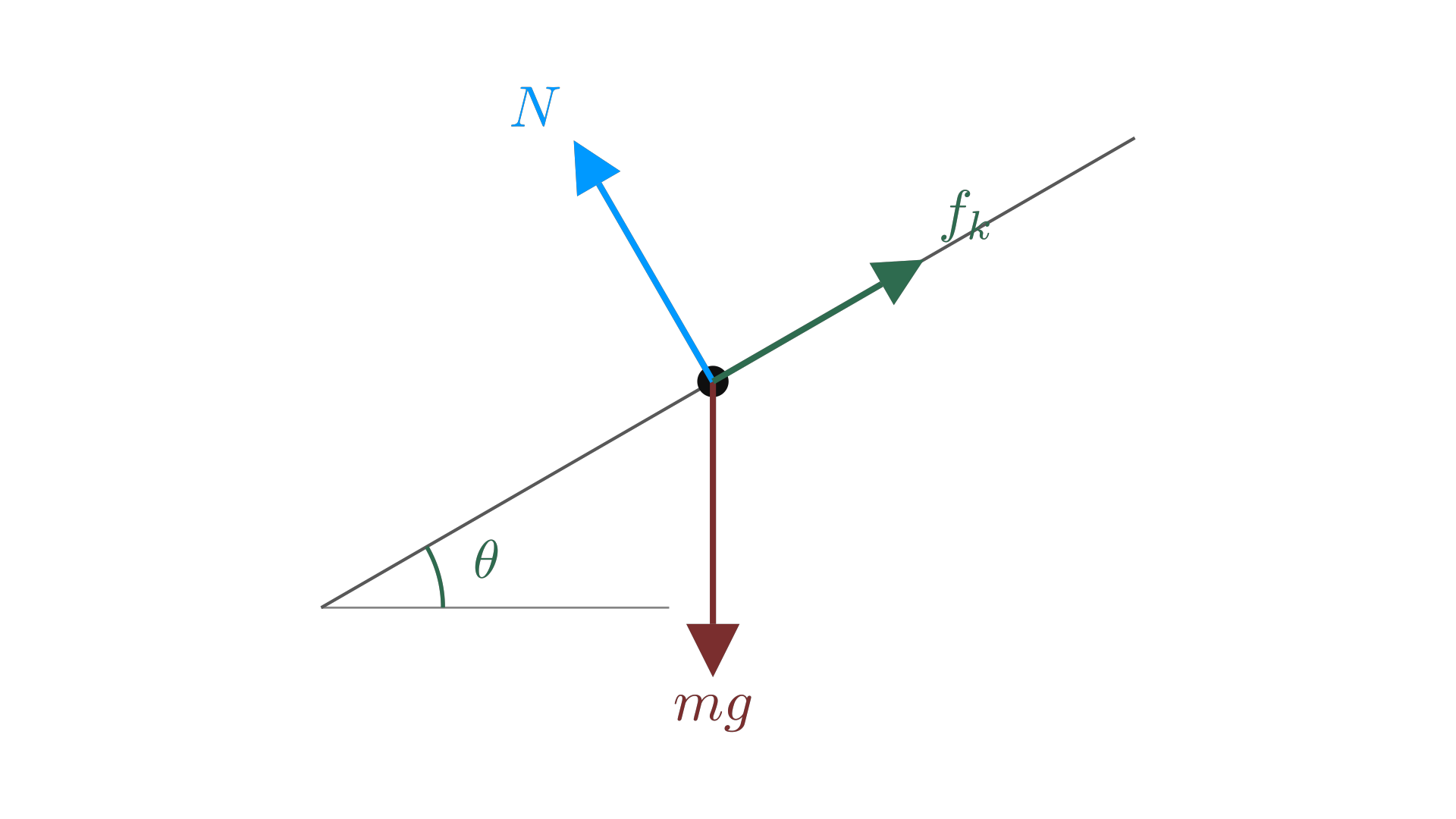
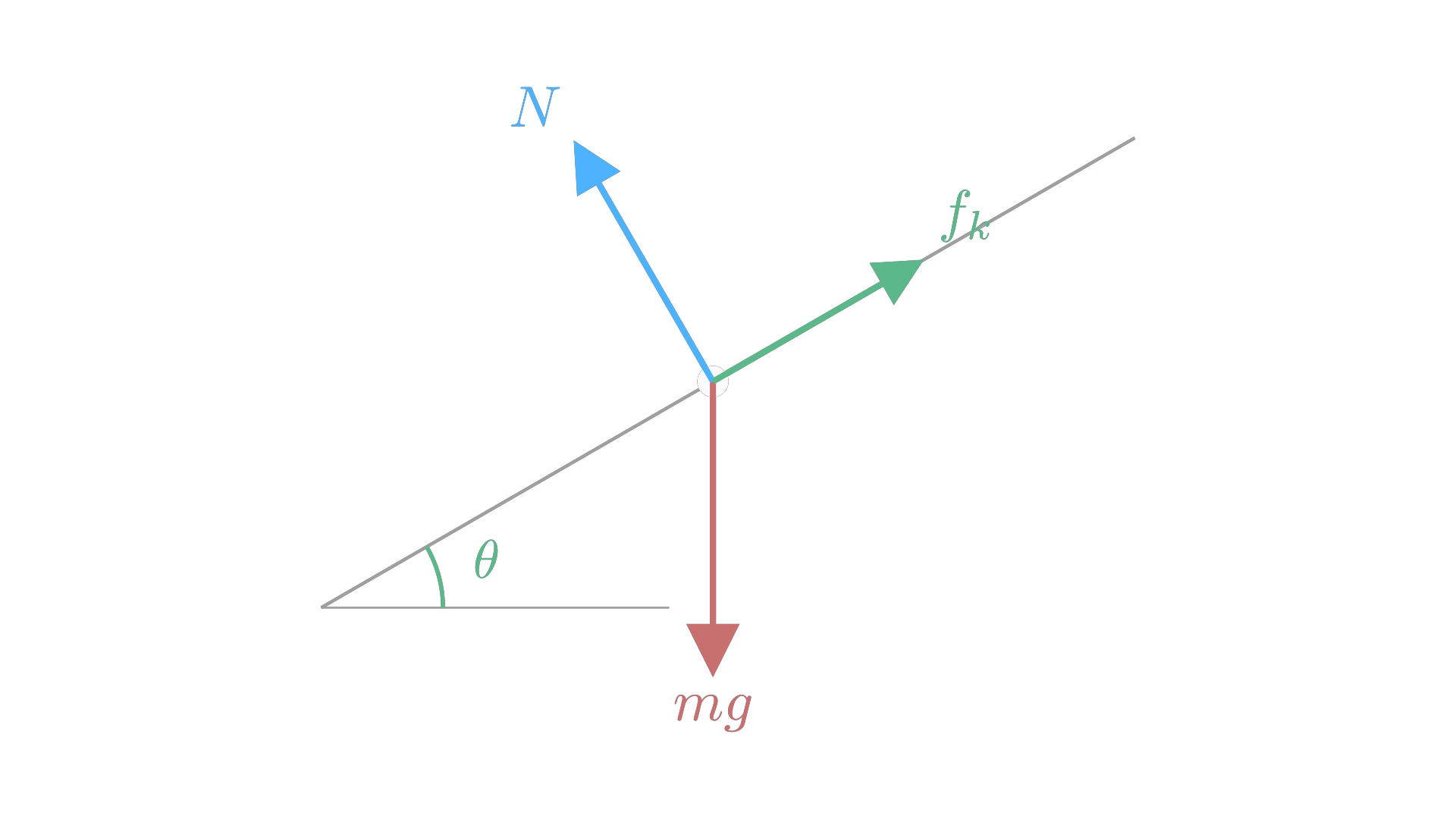
Static friction adjusts its magnitude to prevent slipping, up to a maximum value:
静摩擦力的大小会自动调整以防止滑动,但有最大值上限:
The normal force is the perpendicular component of the contact force; it's not always \(mg\). On an incline at angle \(\theta\), \(F_N = mg\cos\theta\). If someone is pressing down on the object, \(F_N\) increases. If someone pulls up at an angle, \(F_N\) decreases. Always solve for \(F_N\) from the perpendicular equilibrium equation.
法向力是接触力的垂直分量,并不总等于 \(mg\)。在斜角 \(\theta\) 的斜面上,\(F_N = mg\cos\theta\)。若有人向下压物体,\(F_N\) 增大;若有人斜向上拉物体,\(F_N\) 减小。始终通过"垂直方向力平衡"的方程求解 \(F_N\)。
Worked Example: Block on Rough Incline例题:粗糙斜面上的木块
A block of mass \(m\) slides down a rough incline of angle \(\theta\) with coefficient of kinetic friction \(\mu_k\). Find the acceleration.
质量为 \(m\) 的木块沿角度为 \(\theta\)、动摩擦系数(coefficient of friction)为 \(\mu_k\) 的粗糙斜面下滑。求加速度。
FBD: Weight mg down, Normal N ⊥ surface, Friction f_k up the slope
Axes: x down the incline, y ⊥ to surface
FBD:重力 mg 向下、法向力 N 垂直于斜面、摩擦力 f_k 沿斜面向上
坐标轴:x 沿斜面向下,y 垂直于斜面
Worked Example: Does the Block Slip, and How Fast Does It Speed Up?例题:木块会滑动吗?加速度多大?
A 5.0 kg block is placed at rest on a $30°$ incline with $\mu_s = 0.40$ and $\mu_k = 0.30$. Does it slip? If so, find its acceleration. Use $g = 9.8\;\text{m/s}^2$.
一个 5.0 kg 的木块静置于 $30°$ 斜面上,$\mu_s = 0.40$,$\mu_k = 0.30$。它会滑动吗?若会,求其加速度。取 $g = 9.8\;\text{m/s}^2$。
Worked Example: Pushing a Crate That Will Not Budge例题:推不动的木箱
A 20 kg crate rests on a level floor with $\mu_s = 0.50$ and $\mu_k = 0.40$. Find the friction force when you push horizontally with (a) 80 N, (b) 120 N, and the crate's acceleration in each case. Use $g = 9.8\;\text{m/s}^2$.
一个 20 kg 的木箱静止在水平地面上,$\mu_s = 0.50$,$\mu_k = 0.40$。分别用 (a) 80 N、(b) 120 N 的水平力推它,求摩擦力以及木箱的加速度。取 $g = 9.8\;\text{m/s}^2$。
First Principles: The Angle of Repose第一性原理:休止角
Principle. Static friction takes whatever value keeps the block at rest, up to the ceiling $\mu_sF_N$. Slowly tilt a board and find the angle where that ceiling is reached.
原理。静摩擦力取使木块保持静止所需的值,上限为 $\mu_sF_N$。缓慢抬高木板,求恰好达到这个上限的角度。
- Perpendicular to the slope (no acceleration): $F_N=mg\cos\theta$.
- Along the slope at rest: the friction needed is $f_s=mg\sin\theta$.
- Slipping starts when the need meets the ceiling: $mg\sin\theta_{\max}=\mu_smg\cos\theta_{\max}$, so $\tan\theta_{\max}=\mu_s$. The mass cancels.
- 垂直斜面方向(无加速度):$F_N=mg\cos\theta$。
- 静止时沿斜面方向:所需摩擦力为 $f_s=mg\sin\theta$。
- 当所需值达到上限时开始滑动:$mg\sin\theta_{\max}=\mu_smg\cos\theta_{\max}$,所以 $\tan\theta_{\max}=\mu_s$。质量约去。
Limiting-case check. As $\mu_s\to0$, $\theta_{\max}\to0$: any tilt makes the block slide. A large $\mu_s$ pushes $\theta_{\max}$ toward $90°$. For $\mu_s=0.50$, $\theta_{\max}=26.6°$.
极限检验。当 $\mu_s\to0$ 时,$\theta_{\max}\to0$:稍有倾斜木块就会下滑。$\mu_s$ 很大时,$\theta_{\max}$ 趋近 $90°$。若 $\mu_s=0.50$,则 $\theta_{\max}=26.6°$。
Static versus Kinetic Friction at a Glance静摩擦与动摩擦对照
| Feature特征 | Static friction静摩擦 | Kinetic friction动摩擦 |
|---|---|---|
| Surfaces接触面 | not sliding relative to each other彼此之间没有滑动 | sliding relative to each other彼此之间正在滑动 |
| Magnitude大小 | whatever prevents slipping: $0\le f_s\le\mu_sF_N$阻止滑动所需的值:$0\le f_s\le\mu_sF_N$ | fixed: $f_k=\mu_kF_N$固定值:$f_k=\mu_kF_N$ |
| Direction方向 | opposite the slip that would occur without friction与没有摩擦时将发生的滑动方向相反 | opposite the relative velocity of the surfaces与接触面相对速度方向相反 |
| How to find it求法 | from $\sum F=ma$; use $\mu_sF_N$ only at the point of slipping由 $\sum F=ma$ 求;只有在即将滑动时才用 $\mu_sF_N$ | always $\mu_kF_N$, with $F_N$ from the perpendicular equation总是 $\mu_kF_N$,其中 $F_N$ 由垂直方向方程求出 |
Before using $f = \mu_s F_N$, ask whether the surfaces are about to slip; if they are not, static friction is found from $\sum F = ma$, not from $\mu_s F_N$.
使用 $f = \mu_s F_N$ 之前,先问两个表面是否即将滑动;如果不是,静摩擦力要由 $\sum F = ma$ 求出,而不是由 $\mu_s F_N$ 求出。
Find $F_N$ from the perpendicular equation every time, and draw friction opposite the motion (or opposite the direction the object would slide without friction). When a question asks for the angle at which a block just starts to slide, $\tan\theta = \mu_s$ follows in two lines from the free-body diagram; show those lines.
每次都由垂直方向的方程求 $F_N$,并把摩擦力画在与运动方向相反(或与无摩擦时物体将滑动的方向相反)的方向上。题目问木块恰好开始滑动的倾角时,$\tan\theta = \mu_s$ 由受力分析图两行即可推出,要把这两行写出来。
Why is it usually harder to start a heavy box moving than to keep it moving?为什么让一个重箱子开始运动通常比保持它运动更费力?
To start it you must exceed the maximum static friction $\mu_s F_N$; to keep it sliding at constant velocity you only need to match kinetic friction $\mu_k F_N$. For most surface pairs $\mu_s > \mu_k$, so the starting push is larger.
要让它开始运动,必须超过最大静摩擦力 $\mu_s F_N$;要让它匀速滑动,只需与动摩擦力 $\mu_k F_N$ 相等。大多数表面组合满足 $\mu_s > \mu_k$,所以起动时需要的推力更大。
A 2.0 kg block rests on a $20°$ incline with $\mu_s = 0.60$. What is the static friction force on it ($g = 9.8\;\text{m/s}^2$)?一个 2.0 kg 的木块静止在 $20°$ 斜面上,$\mu_s = 0.60$。它所受的静摩擦力是多少($g = 9.8\;\text{m/s}^2$)?
The block is in equilibrium, so friction balances the down-slope part of gravity: $f_s = mg\sin 20° = 19.6(0.342) \approx 6.7$ N, up the slope. The maximum available is $\mu_s mg\cos 20° = 0.60(19.6)(0.940) \approx 11.1$ N, which is larger, confirming that the block stays put. The answer is not 11.1 N.
木块处于平衡,所以摩擦力与重力沿斜面向下的部分平衡:$f_s = mg\sin 20° = 19.6(0.342) \approx 6.7$ N,沿斜面向上。最大可提供值为 $\mu_s mg\cos 20° = 0.60(19.6)(0.940) \approx 11.1$ N,比它大,说明木块确实保持静止。答案不是 11.1 N。
A board is tilted slowly until a block on it starts to slide at $\theta = 25°$. Find $\mu_s$. Would a heavier block of the same material start sliding at a different angle?一块木板被缓慢抬起,放在上面的木块在 $\theta = 25°$ 时开始滑动。求 $\mu_s$。同种材料但更重的木块会在不同的角度开始滑动吗?
At the point of slipping, $mg\sin\theta = \mu_s mg\cos\theta$, so $\mu_s = \tan 25° \approx 0.47$. The mass cancels, so a heavier block of the same material starts sliding at the same $25°$.
恰好滑动时,$mg\sin\theta = \mu_s mg\cos\theta$,所以 $\mu_s = \tan 25° \approx 0.47$。质量被约去,所以同种材料的更重木块也在 $25°$ 时开始滑动。
Spring Forces弹力
- State Hooke's law and explain the meaning of the negative sign.
- Determine a spring constant from the slope of a force-extension graph or from a hanging-mass measurement.
- Calculate the extension of a spring supporting a load in equilibrium.
- Calculate the equivalent spring constant of springs in series and in parallel.
- Apply Newton's second law to an object acted on by a spring force.
- 陈述(
state)胡克定律,并解释(explain)负号的含义。 - 由力-伸长量图像的斜率或悬挂质量的测量确定(
determine)劲度系数。 - 计算(
calculate)处于平衡的弹簧在承载时的伸长量。 - 计算串联与并联弹簧的等效劲度系数。
- 对受弹簧力作用的物体应用牛顿第二定律。
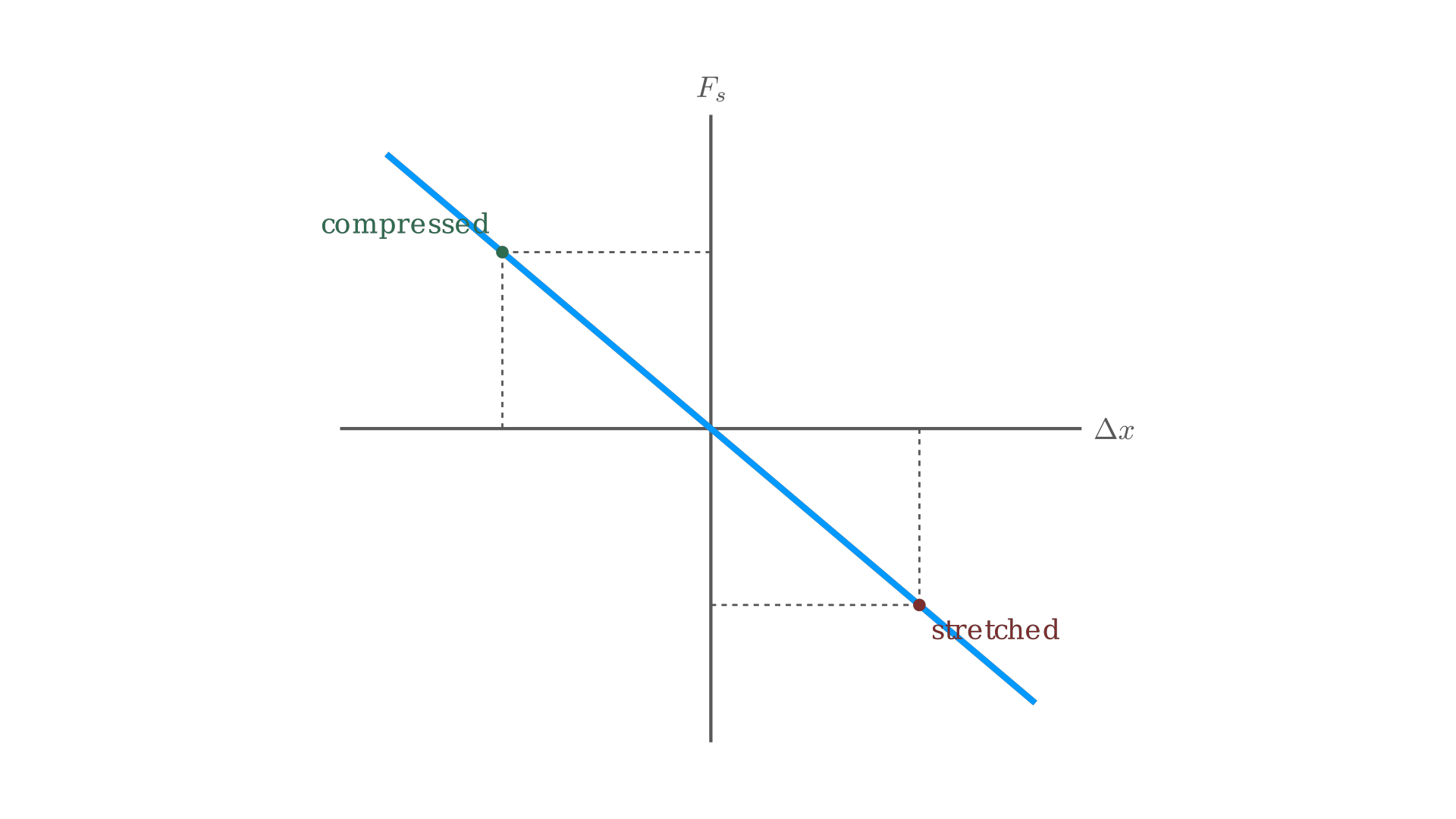
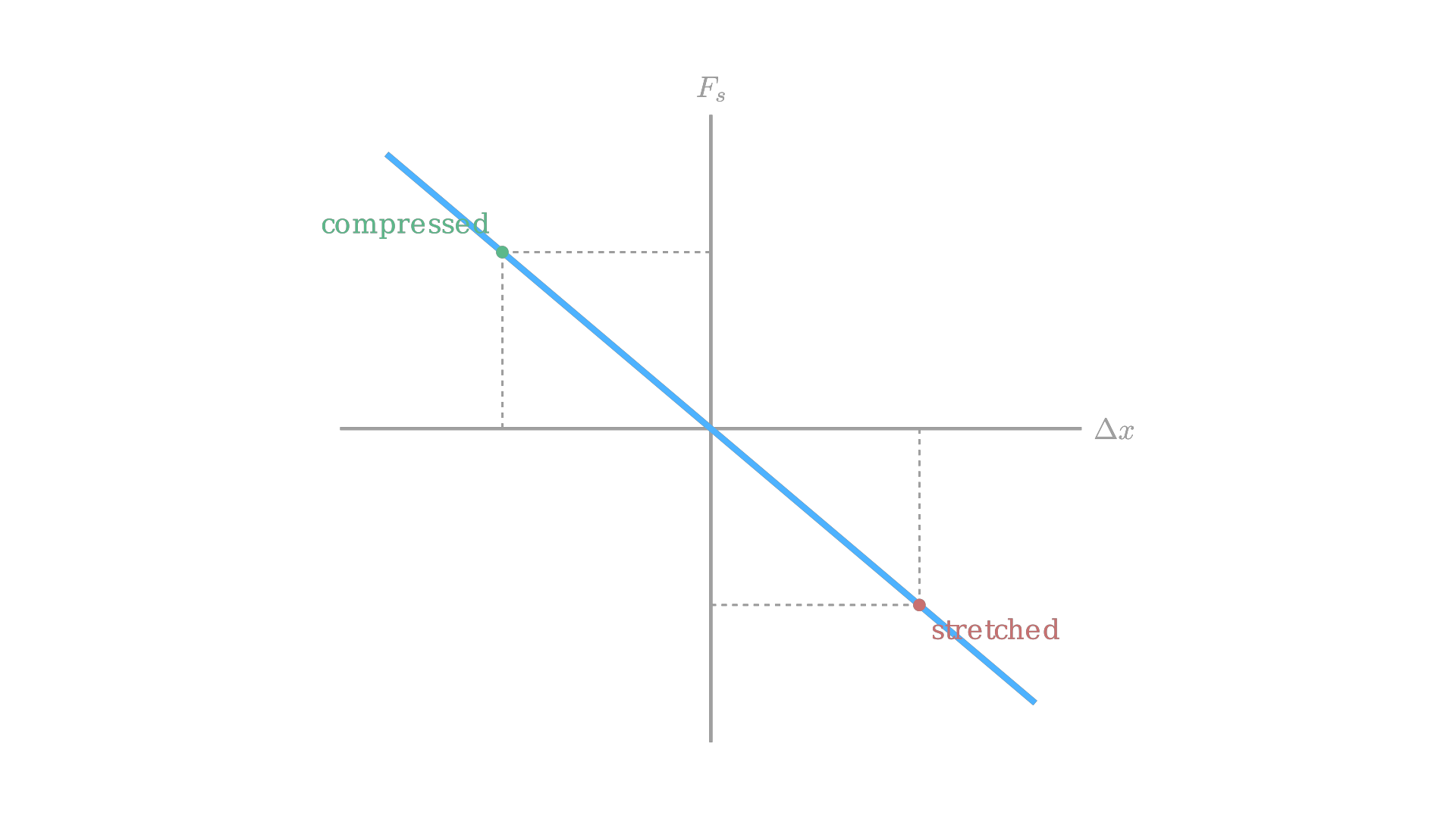
An ideal spring has negligible mass and obeys Hooke's law: the force it exerts is proportional to how far it's stretched or compressed from its natural (relaxed) length. The spring force is always directed back toward the equilibrium position: it's a restoring force.
理想弹簧(ideal spring)质量可忽略,并遵守胡克定律(Hooke's law):弹簧施加的力与其相对自然(松弛)长度的拉伸或压缩量成正比。弹簧力始终指向平衡位置,它是一种回复力(restoring force)。
spring constant),单位 N/m。\(\Delta x\) 是相对松弛长度的位移。负号代表"回复"。Combinations of Springs弹簧的组合 Physics C
| Arrangement连接方式 | Equivalent Spring Constant等效劲度系数 | Key Property关键性质 |
|---|---|---|
| Series (end-to-end)串联(首尾相连) | $$\frac{1}{k_{\text{eq}}} = \frac{1}{k_1} + \frac{1}{k_2} + \cdots$$ | Softer than the softest spring比最软的那根还软 |
| Parallel (side-by-side)并联(并排) | $$k_{\text{eq}} = k_1 + k_2 + \cdots$$ | Stiffer than the stiffest spring比最硬的那根还硬 |
Worked Example: Spring Force and Acceleration例题:弹簧力与加速度
A 0.50 kg block on a frictionless table is attached to a spring with $k = 100\;\text{N/m}$. The block is pulled $0.040\;\text{m}$ from the relaxed position and released. Find the spring force and the block's acceleration at the moment of release. How does the acceleration compare when the block has moved in to $0.020\;\text{m}$ from the relaxed position?
无摩擦桌面上一个 0.50 kg 的木块连着劲度系数 $k = 100\;\text{N/m}$ 的弹簧。把木块从松弛位置拉开 $0.040\;\text{m}$ 后释放。求释放瞬间的弹簧力和木块的加速度。木块运动到距松弛位置 $0.020\;\text{m}$ 时,加速度如何比较?
Worked Example: Two Springs in Series例题:两根串联弹簧
Two springs with constants \(k_1 = 200\;\text{N/m}\) and \(k_2 = 300\;\text{N/m}\) are connected in series. A force of \(60\;\text{N}\) is applied. Find the total extension.
两根弹簧劲度系数 \(k_1 = 200\;\text{N/m}\) 与 \(k_2 = 300\;\text{N/m}\) 串联。施加 \(60\;\text{N}\) 的力,求总伸长量。
Step 1: Equivalent spring constant
第 1 步:求等效劲度系数
Worked Example: Finding k from a Hanging Mass例题:由悬挂质量求劲度系数
A 0.20 kg mass hung from a vertical spring stretches it by 4.9 cm at equilibrium. (a) Find $k$. (b) How far does the spring stretch when the hanging mass is 0.50 kg? Use $g = 9.8\;\text{m/s}^2$.
在竖直弹簧下挂 0.20 kg 的质量,平衡时弹簧伸长 4.9 cm。(a) 求 $k$。(b) 悬挂质量为 0.50 kg 时弹簧伸长多少?取 $g = 9.8\;\text{m/s}^2$。
In experimental questions, find $k$ as the slope of a graph of force (or hanging weight $mg$) against extension, not from a single data pair, and say so: "the spring constant is the slope of the best-fit line".
实验题中,劲度系数 $k$ 要取力(或悬挂重量 $mg$)对伸长量图像的斜率,而不是只用一组数据,并写明"劲度系数等于最佳拟合直线的斜率"。
Measure $\Delta x$ from the spring's relaxed length, convert centimetres to metres before dividing, and keep the direction of the spring force toward the relaxed length when you write $\sum F = ma$.
$\Delta x$ 从弹簧的自然长度量起,相除之前先把厘米换算成米;写 $\sum F = ma$ 时,弹簧力的方向始终指向自然长度。
A 2.0 kg block hangs at rest from a vertical spring and stretches it by $0.050\;\text{m}$. Find the spring constant ($g = 10\;\text{m/s}^2$).一个 2.0 kg 的木块静止悬挂在竖直弹簧下,使弹簧伸长 $0.050\;\text{m}$。求劲度系数($g = 10\;\text{m/s}^2$)。
At rest the spring force balances the weight: $k\Delta x = mg$, so $k = \dfrac{(2.0)(10)}{0.050} = 400\;\text{N/m}$.
静止时弹簧力与重力平衡:$k\Delta x = mg$,所以 $k = \dfrac{(2.0)(10)}{0.050} = 400\;\text{N/m}$。
A spring with $k = 400\;\text{N/m}$ is stretched $0.15\;\text{m}$ from its relaxed length. What force does it exert, and in which direction?劲度系数 $k = 400\;\text{N/m}$ 的弹簧从松弛长度拉长 $0.15\;\text{m}$。它施加的力多大?方向如何?
$F = k\Delta x = (400)(0.15) = 60\;\text{N}$, directed back toward the relaxed length (the restoring direction, opposite to the stretch).
$F = k\Delta x = (400)(0.15) = 60\;\text{N}$,方向指回松弛长度(回复方向,与拉伸方向相反)。
A spring of constant $k$ is cut into two equal halves. What is the spring constant of each half?劲度系数为 $k$ 的弹簧被截成相等的两半。每一半的劲度系数是多少?
$2k$. The original spring is the two halves in series: $\dfrac{1}{k} = \dfrac{1}{k_h} + \dfrac{1}{k_h}$, so $k_h = 2k$. Each half stretches half as much under the same force.
$2k$。原弹簧相当于两个半段串联:$\dfrac{1}{k} = \dfrac{1}{k_h} + \dfrac{1}{k_h}$,所以 $k_h = 2k$。在相同的力下,每一半的伸长量只有原来的一半。
Springs with $k_1 = 100$ N/m and $k_2 = 300$ N/m hang side by side and together support a 2.0 kg mass. Find the extension ($g = 9.8\;\text{m/s}^2$).劲度系数 $k_1 = 100$ N/m 与 $k_2 = 300$ N/m 的两根弹簧并排悬挂,共同承载 2.0 kg 的质量。求伸长量($g = 9.8\;\text{m/s}^2$)。
In parallel, $k_\text{eq} = 100 + 300 = 400$ N/m, so $\Delta x = \dfrac{mg}{k_\text{eq}} = \dfrac{19.6}{400} = 0.049$ m $= 4.9$ cm. The stiffer spring carries three quarters of the load (14.7 N against 4.9 N).
并联时 $k_\text{eq} = 100 + 300 = 400$ N/m,所以 $\Delta x = \dfrac{mg}{k_\text{eq}} = \dfrac{19.6}{400} = 0.049$ m $= 4.9$ cm。较硬的弹簧承担四分之三的负载(14.7 N 对 4.9 N)。
A 3.0 kg block on a frictionless floor is attached to a spring ($k = 150$ N/m) and pulled 0.10 m from the relaxed position, then released. Find its acceleration at the moment of release.无摩擦地面上一个 3.0 kg 的木块连着一根弹簧($k = 150$ N/m),被拉离自然位置 0.10 m 后释放。求释放瞬间的加速度。
$F = k\Delta x = (150)(0.10) = 15$ N toward the relaxed position, so $a = \dfrac{15}{3.0} = 5.0\;\text{m/s}^2$ toward the relaxed position. The acceleration shrinks as the block moves in, because the spring force shrinks with $\Delta x$.
$F = k\Delta x = (150)(0.10) = 15$ N,指向自然位置,所以 $a = \dfrac{15}{3.0} = 5.0\;\text{m/s}^2$,指向自然位置。木块向回运动时 $\Delta x$ 减小,弹簧力随之减小,加速度也随之减小。
Resistive Forces阻力
- Describe a resistive (drag) force that depends on speed and opposes the velocity.
- Explain why an object falling with drag reaches a terminal velocity.
- Calculate terminal velocity from the force balance $kv_T = mg$.
- Calculate the acceleration of a falling object at a given speed with linear drag.
- Sketch and interpret the velocity-time graph of an object approaching terminal velocity.
- Derive $v(t) = v_T(1 - e^{-t/\tau})$ by separating variables in $m\,dv/dt = mg - kv$, and identify $\tau = m/k$.
- 描述(
describe)依赖于速率、方向与速度相反的阻力。 - 解释(
explain)为什么有阻力的下落物体会达到终极速度。 - 由力平衡 $kv_T = mg$ 计算(
calculate)终极速度。 - 计算受线性阻力的下落物体在给定速率时的加速度。
- 画出(
sketch)并解读物体趋近终极速度时的速度-时间图像。 - 对 $m\,dv/dt = mg - kv$ 分离变量,推导(
derive)$v(t) = v_T(1 - e^{-t/\tau})$,并指出 $\tau = m/k$。
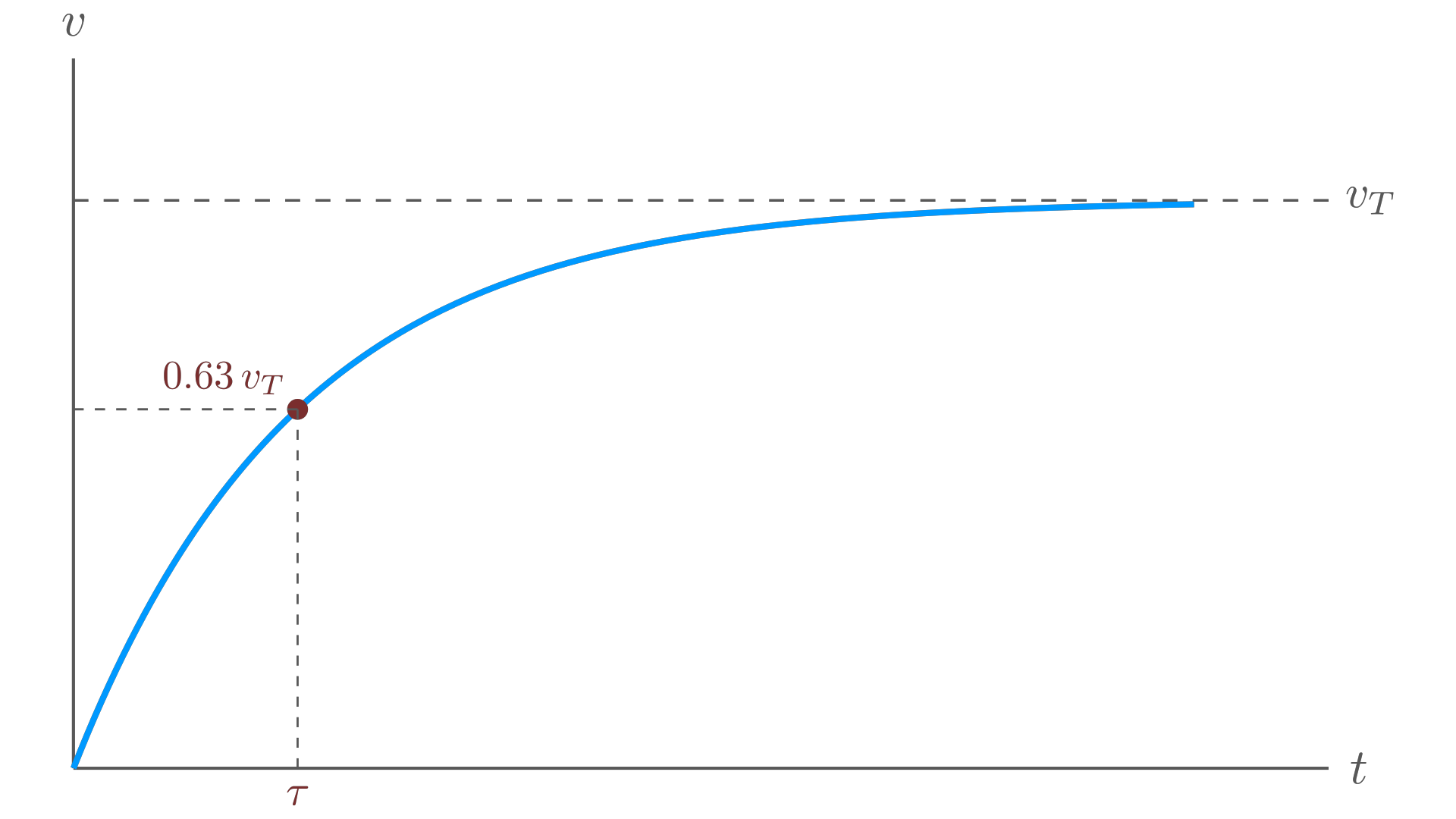
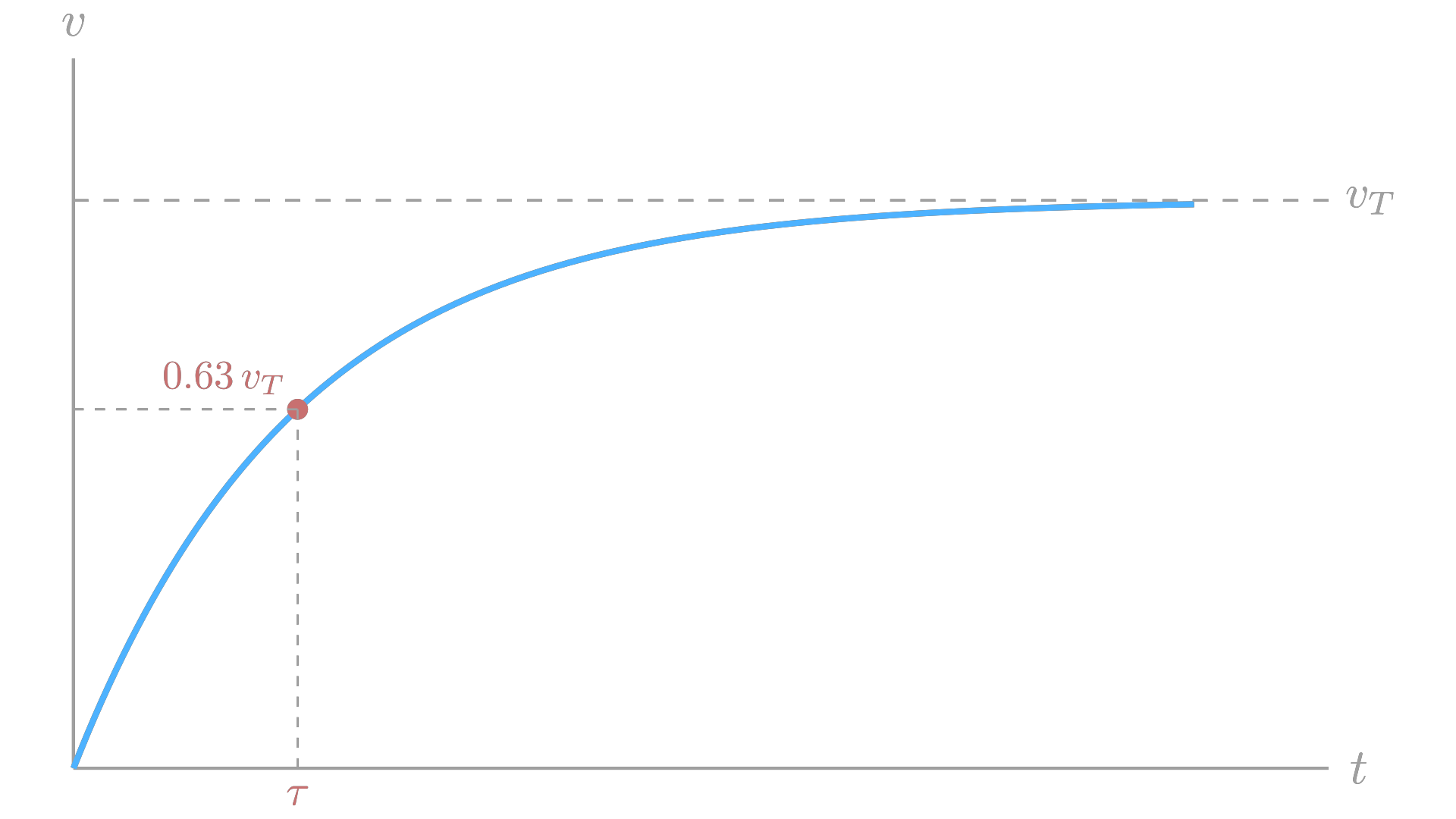
A resistive (drag) force opposes an object's velocity. In the simplest model, it's proportional to speed:
阻力(resistive force / drag)的方向与物体速度方向相反。在最简单的模型中,它与速率成正比:
Applying Newton's second law with both gravity and linear drag yields a first-order linear ODE. For an object falling from rest under gravity with drag \(F_r = -kv\):
同时考虑重力与线性阻力时,牛顿第二定律给出一个一阶线性常微分方程(ordinary differential equation / ODE)。对一个在 \(F_r = -kv\) 阻力下、从静止开始自由下落的物体:
$$m\frac{dv}{dt} = mg - kv$$
Using separation of variables and integrating, the velocity as a function of time is an exponential approach to terminal velocity:
用分离变量法(separation of variables)积分后,速度随时间按指数方式趋向终极速度(terminal velocity):
$$v(t) = \frac{mg}{k}\left(1 - e^{-kt/m}\right) = v_T\left(1 - e^{-t/\tau}\right)$$
where \(v_T = mg/k\) is the terminal velocity and \(\tau = m/k\) is the time constant.
其中 \(v_T = mg/k\) 是终极速度,\(\tau = m/k\) 是时间常数(time constant)。
Terminal Velocity终极速度
The terminal velocity formula depends on which drag model applies:
- Linear drag (low speed, laminar flow): $F_r = kv \;\Rightarrow\; v_T = \dfrac{mg}{k}$
- Quadratic drag (high speed, turbulent flow): $F_r = bv^2 \;\Rightarrow\; v_T = \sqrt{\dfrac{mg}{b}}$
Use whichever model the problem specifies. Read the force law in the prompt before invoking a terminal velocity formula from memory.
终极速度公式取决于题目采用哪种阻力模型:
- 线性阻力(低速、层流
laminar flow):$F_r = kv \;\Rightarrow\; v_T = \dfrac{mg}{k}$ - 二次阻力(高速、湍流
turbulent flow):$F_r = bv^2 \;\Rightarrow\; v_T = \sqrt{\dfrac{mg}{b}}$
用哪种模型完全看题目说明。在动笔套终极速度公式之前,先看清题干给出的力的形式。
Exponential Approach to Terminal Velocity指数趋近终极速度
This is the central calculus derivation of Unit 2. Object of mass $m$ dropped from rest, drag $\vec{F}_r = -k\vec{v}$ (down-positive).
Two constants to memorize: terminal velocity $v_T = mg/k$ and time constant $\tau = m/k$. After one $\tau$, the object reaches $(1 - e^{-1}) \approx 63\%$ of $v_T$; after three $\tau$'s, $\approx 95\%$.
这是第 2 单元的核心微积分推导。质量为 $m$ 的物体从静止下落,阻力 $\vec{F}_r = -k\vec{v}$(取向下为正)。
separation of variables):必须记住的两个常数:终极速度 $v_T = mg/k$ 与时间常数 $\tau = m/k$。经过一个 $\tau$,物体达到 $(1 - e^{-1}) \approx 63\%$ 的 $v_T$;三个 $\tau$ 后达到 $\approx 95\%$。
Worked Example: Deriving v(t) with Drag (Full Work)例题:含阻力推导 v(t)(完整过程) Physics C
An object of mass $m$ is dropped from rest in a medium where drag force is $\vec{F}_r = -k\vec{v}$. Derive $v(t)$.
质量为 $m$ 的物体在阻力为 $\vec{F}_r = -k\vec{v}$ 的介质中从静止下落。推导 $v(t)$。
Worked Example: Terminal Velocity from a Force Balance例题:由力平衡求终极速度
A 2.0 kg object falls through a fluid that exerts a linear drag force of magnitude $kv$ with $k = 0.50$ kg/s. Find its terminal velocity. Use $g = 9.8\;\text{m/s}^2$.
一个 2.0 kg 的物体在流体中下落,流体施加大小为 $kv$ 的线性阻力,$k = 0.50$ kg/s。求其终极速度。取 $g = 9.8\;\text{m/s}^2$。
Worked Example: Acceleration Partway to Terminal Velocity例题:未达终极速度时的加速度
For the same object ($m = 2.0$ kg, $k = 0.50$ kg/s), find the acceleration when its speed is 20 m/s.
对同一物体($m = 2.0$ kg,$k = 0.50$ kg/s),求它速率为 20 m/s 时的加速度。
Read the drag law in the question first ($kv$ or $bv^2$) and use only that one. For terminal velocity, write the force balance (drag = weight) and solve it; do not quote a formula from memory.
先读题目给出的阻力形式($kv$ 还是 $bv^2$),只用这一种。求终极速度时写出力平衡(阻力 = 重力)再求解,不要凭记忆套公式。
When you sketch the $v$-$t$ graph, start it at the origin with slope $g$, bend it smoothly, and draw a dashed horizontal asymptote labelled $v_T$; the curve approaches the line without crossing it.
画 $v$-$t$ 图时,从原点出发、起始斜率为 $g$,平滑弯曲,并画一条标注 $v_T$ 的水平虚线渐近线;曲线趋近这条线但不穿过它。
For a derivation, show each step: Newton's second law as $m\,dv/dt = mg - kv$, the separated form, the integral with limits from $0$ to $v$ and $0$ to $t$, and the final solved expression. Then check both limits, $t = 0$ and $t \to \infty$.
推导题要写出每一步:牛顿第二定律写成 $m\,dv/dt = mg - kv$,分离变量后的形式,带上下限(从 $0$ 到 $v$、从 $0$ 到 $t$)的积分,以及最终解出的表达式。然后检验 $t = 0$ 与 $t \to \infty$ 两个极限。
A skydiver opens a parachute while falling at terminal velocity. Describe the acceleration just after the parachute opens.跳伞员以终极速度下落时打开降落伞。描述降落伞刚打开后的加速度。
The parachute greatly increases the drag at the same speed, so drag now exceeds the weight and the net force points upward. The skydiver slows down (acceleration upward) until drag again equals weight at a new, much lower terminal velocity.
在同样的速率下,降落伞使阻力大大增加,阻力超过重力,净力向上。跳伞员减速(加速度向上),直到阻力在一个低得多的新终极速度下再次等于重力。
With linear drag, how does the terminal velocity change if the mass of the object is doubled and $k$ stays the same?在线性阻力下,若物体质量加倍而 $k$ 不变,终极速度如何变化?
$v_T = mg/k$ is proportional to $m$, so it doubles. The heavier object needs twice the drag to balance its weight, and with $F_r = kv$ that takes twice the speed.
$v_T = mg/k$ 与 $m$ 成正比,所以加倍。更重的物体需要两倍的阻力来平衡重力,而 $F_r = kv$ 时这需要两倍的速率。
A 0.50 kg ball has terminal velocity 25 m/s in a fluid with linear drag. Find $k$, and the ball's acceleration when it moves at 10 m/s ($g = 9.8\;\text{m/s}^2$).0.50 kg 的球在线性阻力流体中的终极速度为 25 m/s。求 $k$,以及球以 10 m/s 运动时的加速度($g = 9.8\;\text{m/s}^2$)。
$k = \dfrac{mg}{v_T} = \dfrac{(0.50)(9.8)}{25} = 0.196$ kg/s. At 10 m/s: $a = g - \dfrac{kv}{m} = 9.8 - \dfrac{(0.196)(10)}{0.50} = 9.8 - 3.92 = 5.88 \approx 5.9\;\text{m/s}^2$ downward. Equivalently $a = g(1 - v/v_T) = 9.8(0.60)$.
$k = \dfrac{mg}{v_T} = \dfrac{(0.50)(9.8)}{25} = 0.196$ kg/s。速率为 10 m/s 时:$a = g - \dfrac{kv}{m} = 9.8 - \dfrac{(0.196)(10)}{0.50} = 9.8 - 3.92 = 5.88 \approx 5.9\;\text{m/s}^2$,方向向下。等价地,$a = g(1 - v/v_T) = 9.8(0.60)$。
Sketch the $v$-$t$ graph for an object dropped from rest with linear drag. State the slope at $t = 0$ and the slope at late times.画出从静止释放、受线性阻力的物体的 $v$-$t$ 图。说明 $t = 0$ 时和很晚时刻的斜率。
The curve starts at the origin with slope $g$ (no drag at $v = 0$), bends over as drag grows, and approaches a horizontal dashed asymptote at $v_T = mg/k$ without crossing it. The slope at late times approaches zero because the net force approaches zero.
曲线从原点出发,起始斜率为 $g$($v = 0$ 时没有阻力),随阻力增大而逐渐弯平,趋近 $v_T = mg/k$ 处的水平虚线渐近线但不穿过它。后期斜率趋近于零,因为净力趋近于零。
Circular Motion圆周运动
- Explain why an object moving in a circle at constant speed is accelerating, and state the direction of that acceleration.
- Identify which real forces (or components) supply the centripetal acceleration in a given situation.
- Apply $\sum F_\text{toward center} = mv^2/r$ to flat curves, banked curves, conical pendulums and vertical loops.
- Calculate the minimum speed at the top of a vertical loop.
- Calculate orbital speed and period for a circular orbit, and use $T^2 \propto R^3$ in ratio problems.
- Explain tangential acceleration in nonuniform circular motion, and calculate the net acceleration as the vector sum of the centripetal and tangential components.
- 解释(
explain)为什么匀速圆周运动的物体在加速,并说明加速度的方向。 - 指认(
identify)在给定情景中由哪些真实的力(或分量)提供向心加速度。 - 把 $\sum F_\text{toward center} = mv^2/r$ 应用于水平弯道、倾斜弯道、圆锥摆与竖直圆轨道。
- 计算(
calculate)竖直圆轨道顶端的最小速度。 - 计算圆轨道的轨道速率与周期,并在比例题中使用 $T^2 \propto R^3$。
- 解释(
explain)非匀速圆周运动中的切向加速度,并把净加速度作为向心分量与切向分量的矢量和来计算。
An object moving along a curved path must be accelerating, even if its speed is constant, because the direction of velocity is changing. The component of acceleration directed toward the center of the circular path is called centripetal acceleration:
沿曲线运动的物体必定在加速,即便速率不变,因为速度方向在变。指向圆周轨道中心的那一加速度分量称为向心加速度(centripetal acceleration):
There is no separate "centripetal force." Centripetal acceleration is produced by whatever real forces (or components of forces) happen to point toward the center: tension, gravity, normal force, friction, or some combination. Always write Newton's second law along the radial direction:
不存在单独的"向心力(centripetal force)"。向心加速度是由那些恰好指向圆心的真实力(或其分量)造成的:张力、重力、法向力、摩擦力或它们的组合。沿径向写出牛顿第二定律即可:
$$\sum F_{\text{toward center}} = \frac{mv^2}{r}$$
First Principles: Where $v^2/r$ Comes From第一性原理:$v^2/r$ 从何而来
Principle. Acceleration is the rate of change of the velocity vector, $\vec a=\Delta\vec v/\Delta t$. At constant speed $v$ on a circle of radius $r$, only the direction of $\vec v$ changes.
原理。加速度是速度矢量的变化率,$\vec a=\Delta\vec v/\Delta t$。以恒定速率 $v$ 沿半径 $r$ 的圆周运动时,只有 $\vec v$ 的方向在变化。
- Position: $\vec r(t)=r\left(\cos\omega t,\ \sin\omega t\right)$, with $\omega=v/r$.
- Differentiate once: $\vec v(t)=r\omega\left(-\sin\omega t,\ \cos\omega t\right)$, of size $r\omega=v$.
- Differentiate again: $\vec a(t)=-\omega^2\vec r(t)$. It points toward the center, with size $\omega^2r=\dfrac{v^2}{r}$.
- 位置:$\vec r(t)=r\left(\cos\omega t,\ \sin\omega t\right)$,其中 $\omega=v/r$。
- 求一次导数:$\vec v(t)=r\omega\left(-\sin\omega t,\ \cos\omega t\right)$,大小为 $r\omega=v$。
- 再求一次导数:$\vec a(t)=-\omega^2\vec r(t)$。它指向圆心,大小为 $\omega^2r=\dfrac{v^2}{r}$。
- In a short time $\Delta t$ the object moves an arc of length $v\Delta t$. Its position vector turns through a small angle $\Delta\theta$.
- The velocity stays perpendicular to the radius, so it turns through the same $\Delta\theta$. The two vector triangles are similar: $\dfrac{|\Delta\vec v|}{v}=\dfrac{v\Delta t}{r}$.
- So $|\Delta\vec v|=\dfrac{v^2\Delta t}{r}$ and $a=\dfrac{|\Delta\vec v|}{\Delta t}=\dfrac{v^2}{r}$. As $\Delta t\to0$, $\Delta\vec v$ points toward the center.
- 在很短的时间 $\Delta t$ 内,物体走过长为 $v\Delta t$ 的弧,位置矢量转过一个小角 $\Delta\theta$。
- 速度始终垂直于半径,所以也转过同样的 $\Delta\theta$。两个矢量三角形相似:$\dfrac{|\Delta\vec v|}{v}=\dfrac{v\Delta t}{r}$。
- 于是 $|\Delta\vec v|=\dfrac{v^2\Delta t}{r}$,$a=\dfrac{|\Delta\vec v|}{\Delta t}=\dfrac{v^2}{r}$。当 $\Delta t\to0$ 时,$\Delta\vec v$ 指向圆心。
Limiting-case check. As $r\to\infty$ at fixed $v$, the path straightens and $a\to0$, as the first law requires. Units: $\mathrm{(m/s)^2/m}=\mathrm{m/s^2}$.
极限检验。$v$ 不变而 $r\to\infty$ 时,路径变直,$a\to0$,与第一定律一致。单位:$\mathrm{(m/s)^2/m}=\mathrm{m/s^2}$。
Key Scenarios几个关键情景
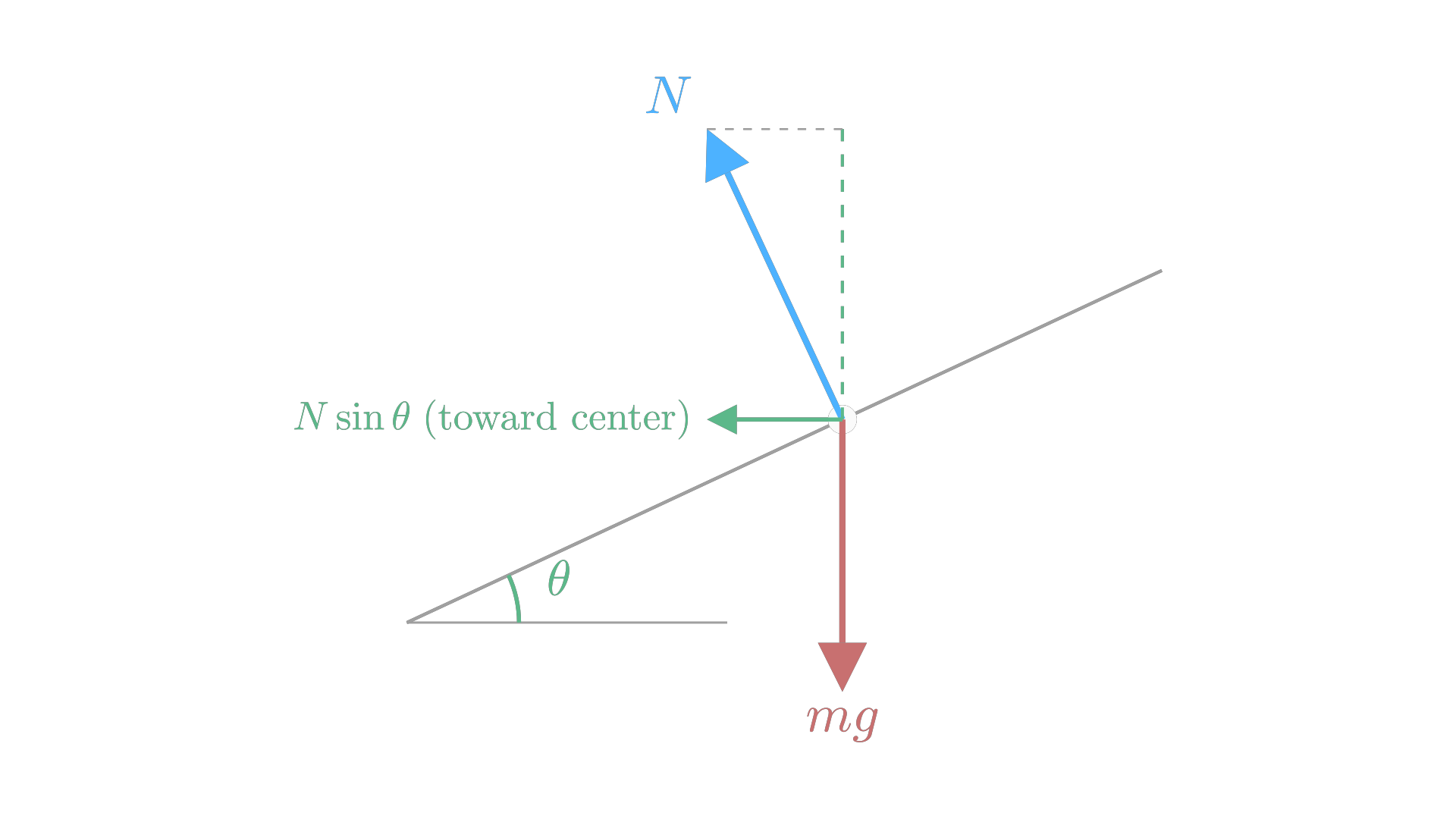
Top of a vertical loop: At the top, both gravity and normal force point toward the center (downward). The minimum speed to maintain contact occurs when \(N = 0\), giving:
竖直圆轨道顶端:在顶端,重力与法向力都指向圆心(向下)。保持接触所需的最小速度发生在 \(N = 0\) 时:
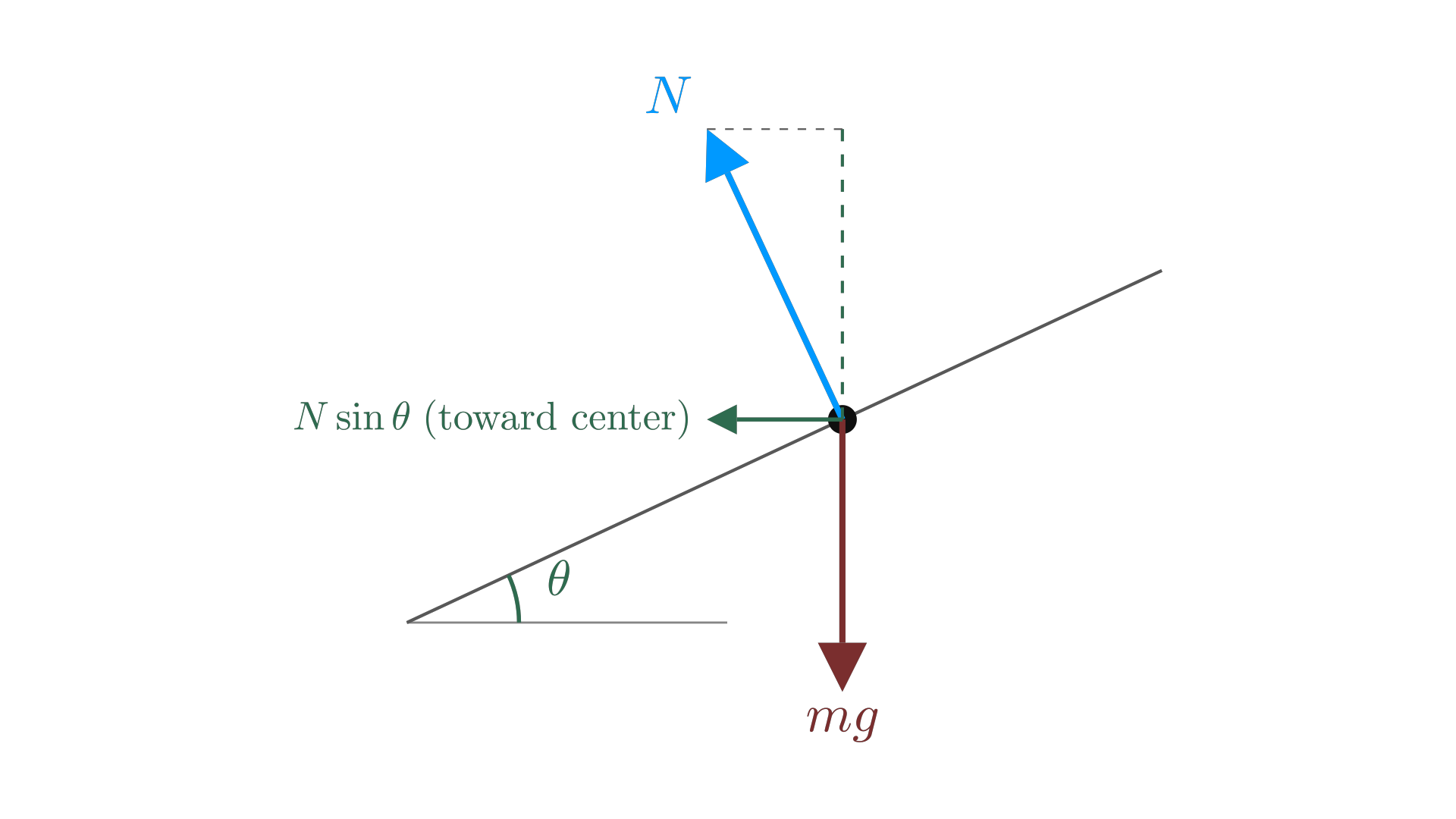
Banked curves: On a banked surface, components of the normal force and friction can both contribute to the centripetal force. The "ideal" banking angle (no friction needed) satisfies \(\tan\theta = v^2/(rg)\).
倾斜弯道(banked curve):在倾斜路面上,法向力与摩擦力的分量都可以为向心力做贡献。"理想"倾角(不需要摩擦力)满足 \(\tan\theta = v^2/(rg)\)。
Conical pendulum: The tension's horizontal component provides centripetal acceleration, while its vertical component balances gravity.
圆锥摆(conical pendulum):张力的水平分量提供向心加速度,竖直分量平衡重力。
Nonuniform Circular Motion非匀速圆周运动
When the speed around a circle is changing, the acceleration has two perpendicular components. The centripetal component $a_c = v^2/r$ points toward the center and measures how fast the direction of the velocity changes. The tangential component $a_t$ points along the velocity (or opposite to it) and measures how fast the speed changes: $a_t = \Delta v/\Delta t$ for a steady change.
沿圆周运动的速率在变化时,加速度有两个相互垂直的分量。向心分量 $a_c = v^2/r$ 指向圆心,表示速度方向变化的快慢。切向分量 $a_t$ 沿速度方向(或与之相反),表示速率变化的快慢:变化均匀时 $a_t = \Delta v/\Delta t$。
The net acceleration is their vector sum, and the components are perpendicular, so its magnitude is found with the Pythagorean theorem:
净加速度是二者的矢量和,两个分量相互垂直,所以用勾股定理求其大小:
Newton's second law applies along each direction separately: the net radial force is $m a_c$ (toward the center) and the net tangential force is $m a_t$. A purely radial force cannot change the speed; only a tangential force component can.
牛顿第二定律在每个方向上分别成立:径向净力为 $m a_c$(指向圆心),切向净力为 $m a_t$。纯径向的力不能改变速率,只有切向的力分量才能。
Physics C When the speed is given as a function of time, $a_t = dv/dt$ at each instant, while $a_c = v(t)^2/r$ changes with it.
Physics C 当速率以时间的函数给出时,每一时刻的 $a_t = dv/dt$,而 $a_c = v(t)^2/r$ 随之变化。
Period & Frequency周期与频率
Kepler's Third Law (Circular Orbits)开普勒第三定律(圆轨道)
For a satellite in circular orbit, gravitational force provides the centripetal acceleration. Setting \(GMm/r^2 = mv^2/r\) and using \(T = 2\pi r/v\) gives:
圆轨道上的卫星,引力提供向心加速度。令 \(GMm/r^2 = mv^2/r\),再代入 \(T = 2\pi r/v\),得开普勒第三定律(Kepler's third law):
Worked Example: Car on a Banked Curve例题:倾斜弯道上的汽车
A car travels at speed \(v\) around a frictionless banked curve of radius \(r\) and bank angle \(\theta\). Derive the condition for no sliding.
汽车以速度 \(v\) 通过半径 \(r\)、倾角 \(\theta\) 的无摩擦倾斜弯道(banked curve)。推导不打滑的条件。
FBD: weight mg downward, normal force N ⊥ to surface
No friction → only N and mg.
Axes: x = horizontal toward center, y = vertical up.
FBD:重力 mg 向下、法向力 N 垂直于路面
无摩擦 → 仅 N 与 mg。
坐标轴:x 取水平指向圆心,y 取竖直向上。
Worked Example: Roller-Coaster Cart at the Top of a Loop例题:过山车在圆轨道顶端
A 400 kg roller-coaster cart goes around the inside of a vertical loop of radius 10 m. (a) Find the minimum speed at the top for the cart to stay on the track. (b) Find the force of the track on the cart at the top when its speed there is 14 m/s. Use $g = 9.8\;\text{m/s}^2$.
一辆 400 kg 的过山车沿半径 10 m 的竖直圆轨道内侧运动。(a) 求车在顶端不脱离轨道的最小速度。(b) 若车在顶端的速度为 14 m/s,求轨道对车的作用力。取 $g = 9.8\;\text{m/s}^2$。
Worked Example: Speeding Up on a Circular Track例题:在圆形赛道上加速
An 800 kg car moves on a flat circular track of radius $20\;\text{m}$. At one instant its speed is $10\;\text{m/s}$ and increasing at $3.0\;\text{m/s}^2$. Find (a) the centripetal acceleration, (b) the magnitude of the net acceleration, (c) the angle of the net acceleration from the inward radial direction, and (d) the net horizontal force on the car.
一辆 800 kg 的汽车在半径 $20\;\text{m}$ 的水平圆形赛道上行驶。某一时刻它的速率为 $10\;\text{m/s}$,并以 $3.0\;\text{m/s}^2$ 增大。求 (a) 向心加速度,(b) 净加速度的大小,(c) 净加速度与指向圆心方向的夹角,(d) 汽车所受的水平净力。
Take the positive direction toward the center of the circle and write $\sum F_\text{toward center} = mv^2/r$ with every real force or component that points along that line; forces pointing away from the center enter with a minus sign. Never add a separate "centripetal force" arrow to the diagram.
取指向圆心为正方向,把沿这条直线的每个真实的力或分量写进 $\sum F_\text{toward center} = mv^2/r$;背离圆心的力取负号。永远不要在图上另加一个"向心力"箭头。
At the top or bottom of a vertical circle, state which way the center is before you write the equation, because the sign of $mg$ depends on it.
在竖直圆周的顶端或底端,写方程之前先说明圆心在哪个方向,因为 $mg$ 的符号取决于此。
A ball on a string is whirled in a horizontal circle and the string breaks. Describe the ball's path just afterward (seen from above).用绳拴着小球在水平面内做圆周运动,绳突然断了。从上方看,描述小球随后的路径。
It moves off along the tangent to the circle at the point where the string broke, in a straight line as seen from above. With no inward force, nothing changes the direction of its horizontal velocity (Newton's first law); it does not fly radially outward.
从上方看,它沿断绳处圆的切线方向做直线运动。没有指向圆心的力,就没有什么能改变它水平速度的方向(牛顿第一定律);它不会沿半径向外飞出。
A car rounds a flat curve of radius 40 m. The coefficient of static friction between tires and road is 0.80. Find the maximum speed without skidding ($g = 9.8\;\text{m/s}^2$).汽车通过半径 40 m 的水平弯道,轮胎与路面的静摩擦系数为 0.80。求不打滑的最大速度($g = 9.8\;\text{m/s}^2$)。
Static friction supplies the centripetal force: $\mu_s mg = \dfrac{mv^2}{r}$, so $v_\text{max} = \sqrt{\mu_s g r} = \sqrt{(0.80)(9.8)(40)} = \sqrt{313.6} \approx 17.7$ m/s. The mass cancels.
由静摩擦力提供向心力:$\mu_s mg = \dfrac{mv^2}{r}$,所以 $v_\text{max} = \sqrt{\mu_s g r} = \sqrt{(0.80)(9.8)(40)} = \sqrt{313.6} \approx 17.7$ m/s。质量被约去。
A satellite orbits Earth in a circle of radius $7.0 \times 10^6$ m. Find its speed and period ($G = 6.674 \times 10^{-11}\;\text{N}\cdot\text{m}^2/\text{kg}^2$, $M_E = 5.97 \times 10^{24}$ kg).一颗卫星沿半径 $7.0 \times 10^6$ m 的圆轨道绕地球运行。求其速率与周期($G = 6.674 \times 10^{-11}\;\text{N}\cdot\text{m}^2/\text{kg}^2$,$M_E = 5.97 \times 10^{24}$ kg)。
Gravity supplies the centripetal force: $\dfrac{GM_E m}{r^2} = \dfrac{mv^2}{r}$, so $v = \sqrt{\dfrac{GM_E}{r}} = \sqrt{\dfrac{(6.674 \times 10^{-11})(5.97 \times 10^{24})}{7.0 \times 10^6}} \approx 7.5 \times 10^3$ m/s. Period: $T = \dfrac{2\pi r}{v} = \dfrac{2\pi(7.0 \times 10^6)}{7.54 \times 10^3} \approx 5.8 \times 10^3$ s, about 97 minutes.
引力提供向心力:$\dfrac{GM_E m}{r^2} = \dfrac{mv^2}{r}$,所以 $v = \sqrt{\dfrac{GM_E}{r}} = \sqrt{\dfrac{(6.674 \times 10^{-11})(5.97 \times 10^{24})}{7.0 \times 10^6}} \approx 7.5 \times 10^3$ m/s。周期:$T = \dfrac{2\pi r}{v} = \dfrac{2\pi(7.0 \times 10^6)}{7.54 \times 10^3} \approx 5.8 \times 10^3$ s,约 97 分钟。
A cart on a circular section of track of radius $9.0\;\text{m}$ has a speed of $12\;\text{m/s}$ that is increasing at $4.0\;\text{m/s}^2$. Find the magnitude of its net acceleration. Does the net acceleration point toward the center?一辆小车在半径 $9.0\;\text{m}$ 的圆弧轨道上,速率为 $12\;\text{m/s}$ 并以 $4.0\;\text{m/s}^2$ 增大。求其净加速度的大小。净加速度指向圆心吗?
$a_c = \dfrac{(12)^2}{9.0} = 16\;\text{m/s}^2$ and $a_t = 4.0\;\text{m/s}^2$, so $a = \sqrt{16^2 + 4.0^2} = \sqrt{272} \approx 16.5\;\text{m/s}^2$. It does not point exactly toward the center: it is tilted about $\arctan(4.0/16) \approx 14^{\circ}$ toward the direction of motion, because the tangential component is nonzero.
$a_c = \dfrac{(12)^2}{9.0} = 16\;\text{m/s}^2$,$a_t = 4.0\;\text{m/s}^2$,所以 $a = \sqrt{16^2 + 4.0^2} = \sqrt{272} \approx 16.5\;\text{m/s}^2$。它并不恰好指向圆心:由于切向分量不为零,它向运动方向偏转约 $\arctan(4.0/16) \approx 14^{\circ}$。
A 0.50 kg bob on a 1.0 m string moves in a horizontal circle with the string at $30^{\circ}$ to the vertical (conical pendulum). Find the tension and the bob's speed ($g = 9.8\;\text{m/s}^2$).一个 0.50 kg 的摆球系在 1.0 m 长的绳上,在水平面内做圆周运动,绳与竖直方向成 $30^{\circ}$ 角(圆锥摆)。求张力和摆球的速率($g = 9.8\;\text{m/s}^2$)。
Vertical: $T\cos\theta = mg$, so $T = \dfrac{(0.50)(9.8)}{\cos 30^{\circ}} \approx 5.7$ N. Horizontal (toward the center): $T\sin\theta = \dfrac{mv^2}{r}$ with $r = L\sin\theta = 0.50$ m, so $\tan\theta = \dfrac{v^2}{rg}$ and $v = \sqrt{rg\tan\theta} = \sqrt{(0.50)(9.8)\tan 30^{\circ}} \approx 1.7$ m/s.
竖直方向:$T\cos\theta = mg$,所以 $T = \dfrac{(0.50)(9.8)}{\cos 30^{\circ}} \approx 5.7$ N。水平方向(指向圆心):$T\sin\theta = \dfrac{mv^2}{r}$,其中 $r = L\sin\theta = 0.50$ m,所以 $\tan\theta = \dfrac{v^2}{rg}$,$v = \sqrt{rg\tan\theta} = \sqrt{(0.50)(9.8)\tan 30^{\circ}} \approx 1.7$ m/s。
Two moons orbit the same planet in circles. Moon A has orbital radius $2.0 \times 10^7$ m and period 4.0 h. Moon B has orbital radius $8.0 \times 10^7$ m. Find the period of Moon B.两颗卫星绕同一行星做圆周运动。卫星 A 的轨道半径为 $2.0 \times 10^7$ m,周期为 4.0 h。卫星 B 的轨道半径为 $8.0 \times 10^7$ m。求卫星 B 的周期。
Both orbit the same planet, so $T^2/R^3$ is the same: $\dfrac{T_B}{T_A} = \left(\dfrac{R_B}{R_A}\right)^{3/2} = 4^{3/2} = 8$. So $T_B = 8(4.0\;\text{h}) = 32$ h.
两颗卫星绕同一行星,所以 $T^2/R^3$ 相同:$\dfrac{T_B}{T_A} = \left(\dfrac{R_B}{R_A}\right)^{3/2} = 4^{3/2} = 8$。于是 $T_B = 8(4.0\;\text{h}) = 32$ h。
Exam Strategy考试策略
Unit 2 has a 20-25% weighting in the multiple-choice section.
From the May 2027 exam, Section I has 42 multiple-choice questions in 85 minutes (50% of the score) and Section II has 4 free-response questions in 95 minutes (50%): one each of mathematical routines, translation between representations, experimental design and analysis, and qualitative/quantitative translation. A calculator is permitted and reference materials are provided.
The course is calculus-based, so in this unit be ready to integrate a force given as $F(t)$ or $F(x)$, to solve the linear-drag equation, and to find a center of mass by integration.
第 2 单元在选择题部分的占比为 20-25%。
自 2027 年 5 月的考试起,第一部分为 42 道选择题,85 分钟(占总分 50%);第二部分为 4 道自由作答题,95 分钟(占 50%),题型各一道:数学推演(mathematical routines)、表示形式转换(translation between representations)、实验设计与分析(experimental design and analysis)、定性/定量转换(qualitative/quantitative translation)。允许使用计算器,并提供参考资料(reference materials)。
本课程以微积分为基础,所以本单元要能对以 $F(t)$ 或 $F(x)$ 给出的力积分、求解线性阻力方程,并用积分求质心。
Unit 2 has an 18-23% weighting in the multiple-choice section.
From the May 2027 exam, Section I has 42 multiple-choice questions in 85 minutes (50% of the score) and Section II has 4 free-response questions in 95 minutes (50%): one each of mathematical routines, translation between representations, experimental design and analysis, and qualitative/quantitative translation. A calculator is permitted and reference materials are provided.
The course is algebra-based, so in this unit work from free-body diagrams, Newton's laws in component form, and force balances such as the ones on an incline or in circular motion.
第 2 单元在选择题部分的占比为 18-23%。
自 2027 年 5 月的考试起,第一部分为 42 道选择题,85 分钟(占总分 50%);第二部分为 4 道自由作答题,95 分钟(占 50%),题型各一道:数学推演(mathematical routines)、表示形式转换(translation between representations)、实验设计与分析(experimental design and analysis)、定性/定量转换(qualitative/quantitative translation)。允许使用计算器,并提供参考资料(reference materials)。
本课程以代数为基础,所以本单元的工作依靠受力分析图、分量形式的牛顿定律,以及像斜面或圆周运动那样的力平衡。
Section Tips分题型提示
Multiple-choice questions can test whether you can identify the correct FBD, apply Newton's second law in component form, or recognize limiting cases (what happens as a variable approaches zero or infinity). Before computing, check limiting cases: they can eliminate wrong answers quickly.
Pay special attention to questions about apparent weight and the distinction between \(F_N\) and \(mg\). In circular-motion questions, check that you have not added "centripetal force" as a separate force.
Multiple Choice)提示选择题可能考察你能否:选对 FBD、把牛顿第二定律按分量写出、识别极限情形(当某个量趋于零或无穷大时会发生什么)。在动笔算之前先查极限情形:它们可以快速排除错误选项。
特别留意视重(apparent weight)类题,以及 \(F_N\) 与 \(mg\) 的区分。做圆周运动题时,检查自己有没有错把"向心力(centripetal force)"作为单独的力加上去。
For the Qualitative/Quantitative Translation (QQT): First make a claim using physical reasoning (no equations), then derive the relevant equation, then connect the two. Show all steps in derivations so the reasoning can be followed.
For experimental design questions, always specify what you measure, what you vary, what you hold constant, and how you extract the desired quantity from a linear graph. When setting up Newton's second law problems, always start with a clearly labeled FBD and state your coordinate system.
FRQ)提示面对定性/定量转换(Qualitative/Quantitative Translation, QQT):先用物理推理给出一个结论性论断(不写方程),再推导相关方程,然后把两者衔接起来。推导一定把每一步都写出来,让推理过程清晰可循。
实验设计题永远要写清:测什么、变什么、控制哪些、如何从线性图中读出目标量。建立牛顿第二定律方程之前,永远从一张清楚标注的 FBD 与明确写出的坐标系开始。
Common Mistakes常见错误
1. Setting \(F_N = mg\) automatically. The normal force depends on all perpendicular forces, not just weight. On an incline or with applied forces, you must solve for it.
2. Adding "centripetal force" to the FBD. Centripetal acceleration is caused by existing forces: gravity, tension, normal, friction. It's not a new force.
3. Confusing static and kinetic friction. Static friction is variable (\(\leq \mu_s F_N\)); kinetic friction is fixed (\(= \mu_k F_N\)). Use the right one for the situation.
4. Wrong sign in Hooke's law. The spring force is \(-k\Delta x\). If \(\Delta x\) is positive (stretched), the force is negative (restoring). Keep your signs consistent with your coordinate system.
5. Forgetting that \(r\) in universal gravitation is from center to center. For a planet of radius \(R\), the surface gravity uses \(r = R\), not the altitude above the surface.
6. Using the wrong mass in the Atwood machine. The system mass is \(m_1 + m_2\) (always), not \(m_2 - m_1\).
1. 不假思索地令 \(F_N = mg\)。法向力取决于所有垂直方向的力,不仅仅是重力。在斜面或有外加力时,必须解方程求 \(F_N\)。
2. 把"向心力"画进 FBD。向心加速度是已有的力(重力、张力、法向力、摩擦力)造成的,不是一个新的力。
3. 混淆静摩擦与动摩擦。静摩擦是可变的(\(\leq \mu_s F_N\)),动摩擦是固定的(\(= \mu_k F_N\))。要按情景选对模型。
4. 胡克定律符号写错。弹簧力为 \(-k\Delta x\)。\(\Delta x\) 为正(拉伸)时,力为负(指向回复)。务必让符号与坐标系一致。
5. 忘记万有引力中的 \(r\) 是质心到质心。半径为 \(R\) 的行星,表面 g 用 \(r = R\),而不是相对地表的高度。
6. 阿特伍德机中用错"系统质量"。系统质量始终是 \(m_1 + m_2\),不是 \(m_2 - m_1\)。
- Not separating variables correctly in resistive-force problems. Practice the equation $m\,dv/dt = mg - kv$ until the separation of variables is automatic.
- Using the constant-acceleration equations when the force is given as $F(t)$ or $F(x)$; integrate $a = F/m$ instead.
- Leaving out the initial condition (or the limits of integration) when integrating for $v(t)$ or $x(t)$.
- 阻力问题中分离变量错误。把方程 $m\,dv/dt = mg - kv$ 的分离变量法练到自动反应。
- 力以 $F(t)$ 或 $F(x)$ 给出时仍套用匀加速运动学方程;应改为对 $a = F/m$ 积分。
- 对 $v(t)$ 或 $x(t)$ 积分时漏掉初始条件(或积分上下限)。
Flashcards闪卡
Click any card to flip it.
点击任意卡片即可翻面。
Unit Quiz单元测验
Gravitation, Drag and Orbits引力、阻力与轨道
shell theorem):均匀球壳对其内部任何物体的净引力为零。一侧的拉力都被对侧的拉力恰好抵消。Worked Example: Atwood Machine with Friction on a Table (FRQ Style)例题:桌面摩擦的阿特伍德机(FRQ 风格)
Mass $m_1 = 3.0\;\text{kg}$ sits on a horizontal table with kinetic-friction coefficient $\mu_k = 0.20$. A light string runs over a frictionless, massless pulley to a hanging mass $m_2 = 5.0\;\text{kg}$. The system is released from rest. Find (a) the acceleration $a$ of the masses and (b) the tension $T$ in the string. Take $g = 9.8\;\text{m/s}^2$.
质量 $m_1 = 3.0\;\text{kg}$ 置于动摩擦系数 $\mu_k = 0.20$ 的水平桌面上。一根轻绳越过无摩擦、无质量的理想滑轮,接到悬挂物 $m_2 = 5.0\;\text{kg}$。系统从静止释放。求 (a) 两物体的加速度 $a$;(b) 绳中张力 $T$。取 $g = 9.8\;\text{m/s}^2$。
Identify)Principle: Newton's second law applied to each mass separately, with the string constraint $|a_1| = |a_2| = a$ (massless inextensible string over a massless pulley). Kinetic friction opposes the motion of $m_1$.
原理:分别对两个质点用牛顿第二定律,并利用绳约束 $|a_1| = |a_2| = a$(无质量不可伸长绳跨过无质量滑轮)。动摩擦力的方向与 $m_1$ 的运动方向相反。
Set Up)Choose "rightward for $m_1$" and "downward for $m_2$" as the positive direction in each FBD; both align with the assumed motion. Friction on $m_1$ is $f_k = \mu_k N = \mu_k m_1 g$, pointing left (opposing the pull).
在各自的 FBD 中选取正方向:"$m_1$ 取向右为正"、"$m_2$ 取向下为正",都与假设运动方向一致。$m_1$ 上的摩擦力 $f_k = \mu_k N = \mu_k m_1 g$,指向左(与拉力相反)。
Execute)Evaluate)Worked Example: Block on Incline with Applied Force at an Angle (FRQ Style)例题:斜面上加力的木块(FRQ 风格)
A block of mass $m = 4.0\;\text{kg}$ rests on an incline of angle $\theta = 30^{\circ}$ with kinetic-friction coefficient $\mu_k = 0.25$. An applied force $F = 30\;\text{N}$ is directed parallel to the incline, pulling the block up the slope. Find the block's acceleration along the incline. Take $g = 9.8\;\text{m/s}^2$.
质量 $m = 4.0\;\text{kg}$ 的木块置于倾角 $\theta = 30^{\circ}$、动摩擦系数 $\mu_k = 0.25$ 的斜面上。外加力 $F = 30\;\text{N}$ 沿斜面向上拉动木块。求木块沿斜面方向的加速度。取 $g = 9.8\;\text{m/s}^2$。
Identify)Principle: Newton's second law in incline coordinates ($x$ along the slope, $y$ perpendicular). Friction opposes motion, so it points down-slope when the block moves up. Normal force comes from the perpendicular force balance.
原理:在斜面坐标系($x$ 沿斜面,$y$ 垂直于斜面)中应用牛顿第二定律。摩擦力方向与运动方向相反:木块沿斜面向上运动时,摩擦力沿斜面向下。法向力由垂直方向力平衡求得。
Set Up)In incline coordinates the gravity vector splits into $-mg\sin\theta$ (down-slope) and $-mg\cos\theta$ (into the surface). Perpendicular balance gives $N = mg\cos\theta$, so $f_k = \mu_k mg\cos\theta$ (down-slope, opposing the assumed up-slope motion).
在斜面坐标系中,重力矢量分解为 $-mg\sin\theta$(沿斜面向下)与 $-mg\cos\theta$(垂直压向斜面)。垂直方向力平衡得 $N = mg\cos\theta$,于是 $f_k = \mu_k mg\cos\theta$(沿斜面向下,与假设的上行运动方向相反)。
Execute)Evaluate)